Posts
AI-SPM 101: How to Continuously Assess, Monitor, and Secure AI Systems in Production
Most organizations can tell you, within a reasonable margin, how many servers they run, which ones are exposed to the internet, and when they were last patched. Ask the same organization how many AI models and agents are running in production, what data each one can touch, which ones have had their system prompts changed in the last month, or whether any of them are currently vulnerable to prompt injection — and the answer, more often than not, is silence.
That gap is the reason AI Security Posture Management exists as its own category now, and why “we ran a red-team exercise before launch” is no longer a defensible security posture for anything that touches production data or takes autonomous action. AI systems don’t hold still. A model gets updated upstream, a new tool gets wired into an agent, a system prompt gets tweaked to fix a support ticket — and the security review from three months ago no longer describes what’s actually running. Securing AI has to be operational, not episodic.
What AI-SPM Actually Means
AI Security Posture Management is the continuous discipline of discovering, assessing, and monitoring the security posture of every AI system an organization runs — models, agents, the data they’re trained on or retrieve from, and the infrastructure wiring it all together.
The name is a deliberate echo of Cloud Security Posture Management. CSPM tools solved a specific problem: cloud environments changed too fast and had too many moving parts for point-in-time audits to keep up, so security teams needed continuous, automated visibility into misconfigurations and drift. AI systems have the same problem, several times over — the assets are less visible, the failure modes are less familiar, and the rate of change is often faster.
Where CSPM asks “is this S3 bucket public, and should it be?”, AI-SPM asks a broader set of questions: What models and agents exist across the organization, including the ones a team spun up without going through procurement? What data can each one access, and is that access scoped to what the task actually requires? Has a model’s behavior drifted since it was last evaluated? Is a guardrail actually catching the attacks it’s supposed to catch, or has it silently regressed? Which of these systems have never been red-teamed at all?
Why This Doesn’t Fit Inside Existing Security Programs
It’s tempting to assume AI risk is just application risk with extra steps, and that existing AppSec and cloud security tooling will eventually absorb it. In practice, three properties of AI systems break that assumption.
The attack surface is the input, not just the code. A traditional vulnerability lives in code — a missing input sanitization check, an outdated library. A prompt injection attack requires no code flaw at all. The model is working exactly as designed; it’s just been manipulated by adversarial content in a document, email, or web page it was asked to process. Static analysis and dependency scanners have nothing to say about that class of risk, because there’s no code defect to find.
Behavior is non-deterministic and drifts on its own. The same prompt can produce different outputs on different runs. A model provider ships a silent update and your agent’s behavior shifts in ways nobody on your team requested. A fine-tune or a new retrieval source changes what the system knows and how it responds. None of this shows up in a code diff, which is what most change-management and CI/CD security gates are built to inspect.
Governance boundaries are blurry by default. A microservice has a clear owner and a defined API contract. An AI agent connected to email, a ticketing system, a code repository, and an internal wiki has a sprawling, often undocumented set of capabilities that grew incrementally as someone added “just one more tool.” Figuring out who owns the risk of that combination — and what the actual blast radius is if it’s compromised — is a governance problem most existing tools were never asked to solve.
The result is a visibility and control gap that sits squarely between AppSec, cloud security, and data governance — and increasingly needs its own operating model.
The Four Pillars of AI Security Operations
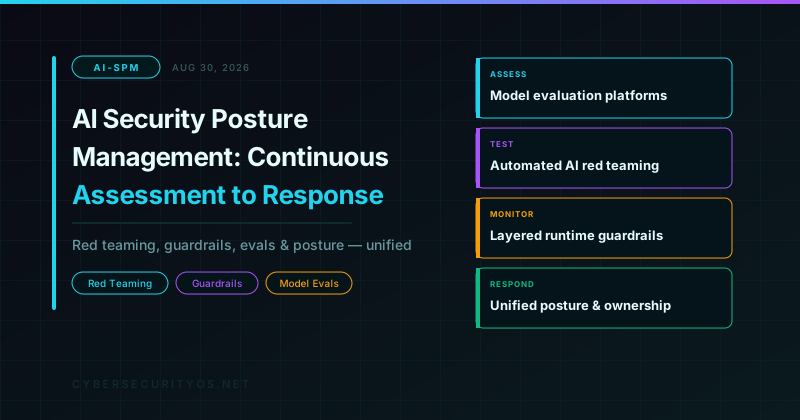
Continuous assessment, monitoring, testing, and response map fairly cleanly onto four tool categories. Most mature AI security programs run some combination of all four, because each covers a phase the others don’t.
Continuous Assessment: Model Evaluation Platforms
Evaluation platforms benchmark models against safety, bias, robustness, and capability criteria — before deployment and on an ongoing basis afterward. This is the closest analog to pre-deployment security testing in traditional software, except the “test suite” has to account for open-ended, adversarial, and subjective inputs rather than deterministic assertions.
The operational value isn’t the one-time score. It’s re-running the same evaluation suite every time a model, prompt, or fine-tune changes, and treating a regression the same way you’d treat a failed security gate in CI — something that blocks a release until it’s understood.
Continuous Testing: AI Red Teaming
Automated red-teaming tools run adversarial prompts, jailbreak attempts, and injection payloads against a model or agent to find exploitable weaknesses before an attacker does. This has matured quickly — frontier labs now run internal automated red-teamers at a scale and iteration speed no human team can match, and that same automated, iterative testing model is what’s showing up in commercial and open-source red-teaming tooling aimed at defenders.
The operational shift that matters: red teaming an AI system isn’t a pre-launch checkbox, it’s a recurring test suite. The threat surface changes every time the model, the system prompt, or the tool integrations change — which for most agentic systems is closer to weekly than quarterly.
Continuous Monitoring: Guardrails
Guardrails are runtime controls that sit in front of and behind a model — inspecting prompts before they reach it and outputs before they reach the user or take an action. They catch what red-teaming and evaluation can’t: the attack nobody thought to test for, arriving in production, in real time.
Guardrails work best layered rather than singular: input filtering for known injection patterns, output filtering for data leakage and policy violations, and behavioral monitoring for anomalous tool use by an agent — a sudden spike in database writes, a request to a domain it’s never called before. A single guardrail catches a single failure mode. Layered guardrails catch the ones that get past each other.
Continuous Response: AI-SPM Platforms
This is the layer that turns the other three into an operating program instead of a collection of disconnected tools. AI-SPM platforms maintain the inventory of AI assets across the organization, aggregate findings from evaluation, red-teaming, and guardrail tools into a single posture view, assign ownership, and drive remediation and incident response when something is found.
Without this layer, an organization can have excellent red-teaming, solid guardrails, and rigorous evaluation running in three different tools that never talk to each other — and still have no idea how many AI systems exist across the company, or which one just failed a test three weeks ago and was never fixed.
Traditional Security Operations vs. AI Security Operations
| Traditional AppSec / CSPM | AI Security Operations | |
|---|---|---|
| Primary attack surface | Code defects, misconfigurations | Adversarial inputs, model behavior, tool access |
| Testing cadence | Pre-release scans, periodic pen tests | Continuous — triggered by any model, prompt, or integration change |
| Determinism | Same input, same output, every time | Same input can produce different outputs across runs |
| Change trigger | A code commit or infrastructure change | Also: a provider model update, a prompt edit, a new tool connection |
| Inventory challenge | Known asset types (servers, repos, services) | Shadow AI — agents and models spun up outside procurement |
| Core tooling | SAST/DAST, dependency scanners, CSPM | Eval platforms, AI red-teaming, guardrails, AI-SPM |
Building the Operating Model
Getting from “we have some AI security tools” to “we have an AI security operations program” is a sequencing problem more than a purchasing decision.
Inventory before anything else. You cannot assess, monitor, or red-team an AI system you don’t know exists. Most organizations underestimate how many models and agents are running — a marketing team’s chatbot, a developer’s internal coding assistant, a vendor’s embedded AI feature — because these get adopted outside the channels that would normally trigger a security review. Discovery has to include this shadow AI, not just the sanctioned deployments.
Establish an evaluation baseline before you need one. Run your evaluation suite against a model before it ships, so a later regression has something to be measured against. Teams that skip this step end up trying to determine whether a model “got worse” with no baseline to compare it to.
Treat red-teaming as a pipeline stage, not a launch gate. The organizations getting this right have wired automated adversarial testing into the same CI/CD pipeline that runs their other security scans — triggered by a prompt change, a new tool integration, or a scheduled interval, not just a major release.
Layer guardrails at the boundaries that matter most. Start with the highest-consequence boundaries — anywhere the system touches untrusted external content, or anywhere it can take an action with real-world effect (sending an email, modifying a record, executing code) — rather than trying to guard everything uniformly on day one.
Give the whole thing an owner. AI-SPM tooling only produces value if someone is accountable for acting on what it finds. A posture dashboard nobody is assigned to triage is a compliance artifact, not a security control.
Where This Is Headed
The pattern here isn’t new — it’s the same maturity curve cloud security went through a decade ago, compressed into a much shorter timeline because AI adoption is happening faster than cloud adoption ever did. First came ad hoc usage, then point security tools for the most obvious risks, then a recognition that the point tools needed to be unified into a continuous operating program with clear ownership.
The organizations that get ahead of this treat AI security the way they’d treat any other production system with a fast-moving attack surface: instrument it, test it continuously, and assume the review you did last quarter no longer describes what’s running today. The ones that don’t will find out the hard way — usually from an incident, not an audit.
If you’re looking for where to start, the non-human identity angle is a good companion piece — every AI agent in your inventory is also a credentialed identity, and securing what it can access is half the AI-SPM problem. For a look at how fast the offensive side of this is moving, see GPT-Red: What OpenAI’s Automated Red-Teamer Means for AI Security.
FAQ
What is AI Security Posture Management (AI-SPM)?
AI-SPM is the practice of continuously discovering, assessing, and monitoring the security posture of an organization’s AI systems — models, agents, datasets, pipelines, and the infrastructure connecting them. It functions like Cloud Security Posture Management for AI: it inventories what AI assets exist, flags misconfigurations and excess permissions, tracks vulnerabilities, and gives security teams a continuously updated view of AI-specific risk rather than a point-in-time audit.
How is AI-SPM different from AI red teaming and guardrails?
They cover different phases of the same loop. Red teaming actively probes a model or agent for exploitable weaknesses, the way a penetration test does. Guardrails are runtime controls that inspect prompts and outputs and block unsafe behavior as it happens. AI-SPM sits above both — maintaining the asset inventory, aggregating findings, tracking posture over time, and routing issues to owners.
Do I need AI-SPM if I already have a CSPM or traditional AppSec program?
Yes, in most cases. CSPM understands cloud misconfigurations, not model provenance, prompt injection surface, or the non-deterministic behavior of an LLM-based agent. AppSec scanners look for known code-level vulnerability classes, not adversarial inputs that manipulate a model’s reasoning. AI-SPM fills the gap those tools weren’t designed to cover, and typically integrates with them rather than replacing them.
What tool categories make up an AI security operations program?
Four categories work together: model evaluation platforms for continuous assessment, AI red-teaming tools for continuous testing, guardrail frameworks for continuous monitoring at runtime, and AI-SPM platforms that unify inventory, posture scoring, and response across all of it.
How often should AI systems be red-teamed once they’re in production?
Continuously, not on a fixed calendar. AI systems change behavior when the model is updated, the system prompt changes, or a new tool or data source is connected — none of which necessarily trigger a formal change review. Automated, continuous adversarial testing is what most red-teaming and AI-SPM tooling is built to support.
Conclusion
The core failure mode in AI security right now isn’t a missing tool — it’s treating AI security as a project with an end date instead of an operating discipline. A red-team exercise before launch, a guardrail configured once and left alone, an evaluation run that never gets repeated — all of it describes a system that no longer exists by the time anyone checks on it again.
AI-SPM, paired with continuous evaluation, red-teaming, and layered guardrails, is what closes that gap. Start with inventory, because nothing else works without it. Then build the cadence — assessment, testing, and monitoring running continuously, not quarterly — and make sure someone owns what all of it finds.