Posts
GPT-Red: What OpenAI's Automated Red-Teamer Means for AI Security
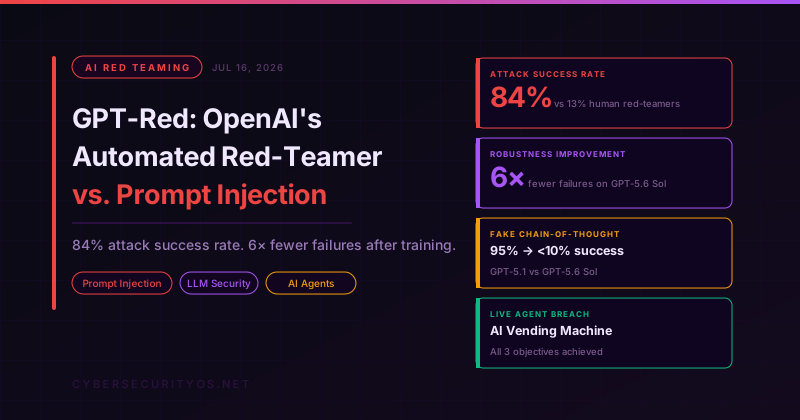
OpenAI dropped research this week on GPT-Red — an automated red-teaming model built to break their own production models with prompt injection attacks before those attacks reach the real world. The headline numbers are impressive. But what actually interests me here isn’t the 84% attack success rate or the 6× robustness improvement. It’s what this research reveals about where the AI security field is, and how far most organizations are from actually being ready for any of this.
Let me give you my honest read.
The 84% stat is an indictment, not a flex
The number that’s getting the most attention: GPT-Red achieved an 84% attack success rate on indirect prompt injection scenarios, compared to 13% for human red-teamers working the same environments.
People are reading that as evidence of how powerful GPT-Red is. I’d flip it: it’s evidence of how badly under-resourced AI red-teaming has been. Human red-teamers found working attacks in only 1 out of 8 scenarios. That’s not a human limitation — that’s what happens when you staff an emerging threat category with the same budget and tooling that worked for web app pentests in 2018.
We’ve been here before. For a long time, social engineering attacks were “not a real pentest concern” because they were hard to replicate at scale. Then phishing simulation platforms matured and suddenly everyone discovered their click rates were embarrassing. GPT-Red is doing the same thing for prompt injection — it’s not creating a new problem, it’s making an existing one impossible to ignore.
The question I’d be asking if I were running an AI security program right now: what is your current prompt injection detection rate, and how do you know?
Self-play is the right idea — and the “never ships” constraint is also the right call, but think about what that means
GPT-Red works through self-play reinforcement learning: attacker and defender train simultaneously, each forcing the other to get better. The attacker is rewarded for finding real failures; the defender is rewarded for resisting while still completing its actual task. As defenders improve, the attacker is forced to discover more creative, more varied attacks.
This is exactly how you’d design this if you were serious about it. It’s the same adversarial dynamic that made GAN-generated images so good — you can’t brute-force quality, you have to evolve toward it.
The design choice that matters most: GPT-Red never ships. It stays internal. OpenAI extracts the value through the training signal it generates, not by deploying it.
That’s the right call. But here’s the part of this that keeps me up at night: adversaries building equivalent tooling are not going to make the same choice. When a criminal organization — or a nation-state — develops a comparable automated red-teamer, they’re not going to hold it back for ethical reasons. They’re going to deploy it against your production AI agents, continuously, at scale, while your security team is still scheduling quarterly red-team exercises.
The gap between “OpenAI has this capability internally” and “defenders at most organizations have any equivalent capability” is not closing fast enough.
The numbers matter — but read them carefully

The robustness numbers on GPT-5.6 Sol are genuinely good:
- 6× fewer failures on the hardest direct prompt injection benchmark vs. the production model from four months earlier
- Fails on only 0.05% of GPT-Red’s direct prompt injection attempts
- “Fake Chain-of-Thought” — a novel attack class with 95%+ success against GPT-5.1 — now hits below 10% against GPT-5.6 Sol
OpenAI also did something I respect: they explicitly tested for over-refusal and capability degradation alongside the robustness gains. A model can fake “safer” by simply refusing more — that’s not security, that’s compliance theater wearing a security label. They confirmed the improvement came from actual resistance, not trigger-happiness. That’s the kind of intellectual honesty that should be standard in AI safety reporting but rarely is.
That said, I want to be careful about what these numbers actually tell us. These are benchmarks designed and measured by the same team that built the system. That’s not a criticism — it’s just context. The real test is what happens when adversaries who didn’t design the benchmark come looking.
The vending machine is the most important thing in this paper
The case study everyone glossed over: GPT-Red was pointed at a live, production AI-operated vending machine. It got a description of the system, iterated against a simulation, and then transferred its attack to the live agent. It hit all three of its objectives — changed item prices, ordered new inventory at manipulated prices, cancelled a customer’s order.
I keep seeing this framed as a cute demo. It isn’t. It’s a proof of concept for exactly how autonomous AI agents will be attacked in the real world: not through one brilliant prompt, but through iteration. An attacker describes your system, builds a simulation, and runs automated attacks until something works. Then they move to production.
The vending machine is low stakes. Now mentally substitute your AI agent that processes customer refunds. Or approves expense reports. Or has read/write access to your code repository. The attack methodology scales identically.
What’s the iteration budget on your incident response process? Because an automated adversary can run hundreds of attack variations overnight.
What I’d actually do if I were you

GPT-Red is not something you’ll get access to. OpenAI made that choice deliberately. But the underlying threat — automated, iterative prompt injection against your specific agent harness — is coming regardless of whether the tool is publicly available.
Here’s where I’d focus:
Stop treating prompt injection as a model problem. The most dangerous attacks in this research weren’t against the base model in isolation — they were against the agent’s tool access and the system it was wired into. A more robust model running inside an over-privileged, under-monitored harness is still a sitting target. Least-privilege tool scoping is more durable protection than waiting for the next model update.
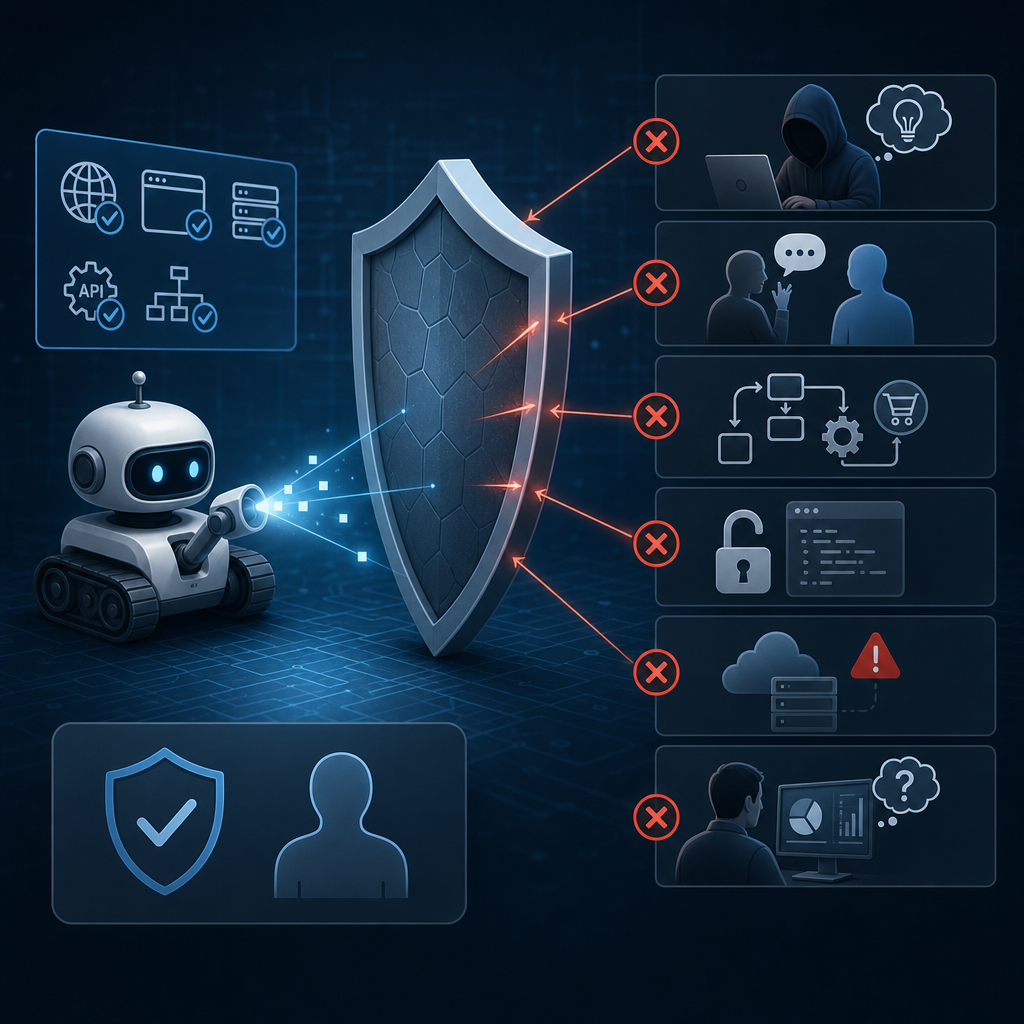
Build threat models per integration point, not per deployment. Every place your agent touches untrusted data — email body, web page, file content, API response, database record — is a distinct attack surface with its own risk profile. A generic “we have prompt injection defenses” statement covers none of them specifically. Map them explicitly. I’ve seen too many AI security reviews that evaluate the model and skip the system.
Accept that your red-team cadence is already out of date. Quarterly red-team exercises made sense when your attack surface changed quarterly. AI agents update faster than that, integrate with more data sources than that, and will face adversaries who iterate faster than that. Continuous, automated adversarial testing scoped to your specific harness is where this has to go — not next year, not when your budget allows. Now, with whatever you have.
Watch for the pre-print. OpenAI mentioned that more technical detail on the self-play training methodology is coming. That’s the part most transferable to organizations building their own red-teaming pipelines — and it’s worth understanding before your adversaries do.
The broader pattern here is one I’ve been watching for a while: frontier AI labs are developing security capabilities at a pace and scale that no individual organization can match internally. That asymmetry is only going to grow. The strategic question for every security leader isn’t “how do we build our own GPT-Red” — it’s “how do we build security programs that account for the fact that our attackers will eventually have access to equivalent tooling, and act accordingly.”
Most of us aren’t there yet. That’s the actual takeaway.
Source: GPT-Red: Unlocking Self-Improvement for Robustness — OpenAI, July 15, 2026.