Posts
OS Weekly: AI Becomes the Adversary's Newest Hire
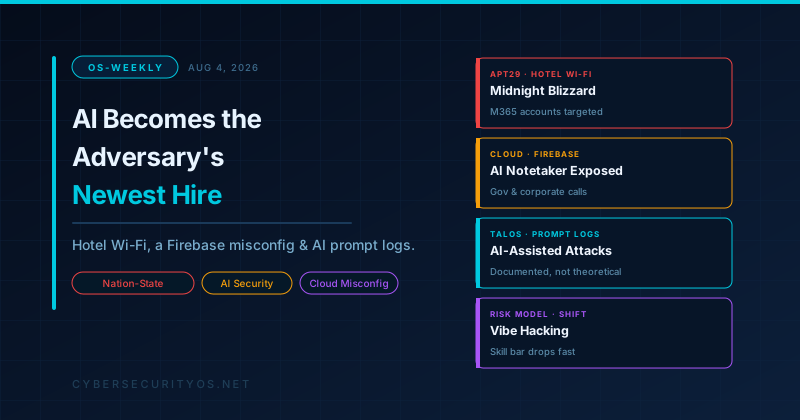
This week made the AI-in-cybersecurity conversation a lot less theoretical. A Russian state-sponsored group turned hotel Wi-Fi into a beachhead against Microsoft 365 accounts, a misconfigured AI notetaker exposed government and corporate video calls, and Cisco Talos published hard data on adversaries actively using mainstream AI coding assistants to build attacks. We close out with a federal AI policy move and two consumer-security stories worth forwarding to the people in your life who buy cheap smart-home gear.
Critical Threats & Active Exploits
Midnight Blizzard is breaching Microsoft 365 through hotel Wi-Fi

Microsoft has attributed a global campaign targeting hospitality-sector Wi-Fi networks to Midnight Blizzard (APT29) — the Russian intelligence-linked group best known for the SolarWinds supply chain attack. The operation deploys custom malware over hotel networks specifically to compromise the Microsoft 365 accounts of traveling business users, exploiting the assumption that a hotel’s network is a safe place to check email.
This is a reminder that “convenient” and “trusted” are not the same thing, especially for anyone who travels with access to sensitive accounts. If your organization hasn’t mandated VPN or personal-hotspot use on hotel and public Wi-Fi, this campaign is a strong argument for making that policy non-negotiable — and a good prompt to review conditional-access rules for travel-pattern anomalies.
A misconfigured AI notetaker let strangers into government and corporate calls

The AI-powered meeting assistant tl;dv shipped with a Google Firebase misconfiguration that allowed any authenticated user to query and access other users’ meeting data — including, potentially, joining calls they weren’t invited to. The flaw wasn’t in the AI model itself; it was in the database access rules meant to isolate one customer’s data from another’s.
This is a clean case study for anyone learning cloud security: the AI layer gets the headlines, but the boring backend permissions are usually where the real exposure lives. If your team has adopted an AI notetaker or meeting-transcription tool, it’s worth asking the vendor directly how tenant data is isolated at the database level, not just whether the product is “SOC 2 compliant.”
AI Weaponization & Threat Intelligence
“Vibe hacking” is breaking the old risk-assessment hierarchy

The Hacker News lays out a case that should unsettle anyone still ranking cyber threats purely by attacker sophistication. The industry’s long-standing hierarchy — nation-states at the top, organized crime next, “script kiddies” at the bottom — assumes offensive capability scales with technical expertise. AI-assisted “vibe hacking” is decoupling those two things: a comparatively unskilled actor with the right prompts and access to capable models can now execute attacks that used to require real technical depth.
For aspiring security professionals, this is genuinely good news and bad news at once. The bad news is that risk models built around “who’s likely behind this” are getting less reliable. The good news is that the skills that still matter most — pattern recognition, incident response judgment, and knowing when something looks off — are exactly the things AI tools don’t replace. If you’re building a name in the field alongside those skills, it’s worth having somewhere to point people to — a CTF writeup index, a resume page, a link hub — and Carrd is the fast, no-bloat way to stand one up in an afternoon with nothing to patch or maintain. Affiliate link — signing up may support CyberShield at no extra cost to you.
Talos has the receipts on AI-assisted attacks

Cisco Talos analyzed real prompt logs from threat actors using mainstream AI coding tools — including Claude Code, CodeX, Cursor, and Gemini — to understand exactly how adversaries are leveraging cloud-based AI in the wild. The analysis moves the conversation from “AI could theoretically help attackers” to “here is documented evidence of how it already does,” covering phishing content generation, malware development assistance, and social engineering support.
This is the kind of data-driven threat intel that should shape defensive roadmaps, not just conference talks. If AI-assisted attack tooling is showing up in real prompt logs today, AI-assisted detection and anomaly-hunting needs to be treated as core infrastructure, not an experimental bolt-on. Turning findings like this into something a team will actually read doesn’t have to eat your whole evening either — we run our own threat-intel write-ups through a Canva kit built for security folks, dark-mode palettes and monospace accents included. Affiliate link — signing up may support CyberShield at no extra cost to you.
Policy & Consumer Security
The White House is reviewing a “Frontier Model” framework with top AI labs

The White House has presented major AI companies with a “Frontier Model” framework aimed at guiding the responsible development and deployment of advanced AI systems, with an emphasis on transparency, accountability, and managing national-security-relevant risk. Specifics are still light, but the initiative signals a more proactive federal posture toward frontier AI oversight.
Government AI policy is quickly becoming relevant career context, not background noise, for anyone working at the intersection of AI and security. Whatever shape this framework ultimately takes, it’s likely to influence procurement requirements, compliance expectations, and the kinds of AI-security roles that get funded over the next few years.
That $30 streaming stick might be running an ad-fraud botnet

Krebs on Security’s latest look at generic “unlimited streaming for a one-time fee” TV boxes goes beyond the already-known risk of these devices covertly sharing your internet connection with strangers. New analysis shows some of these boxes also impersonate mobile phones to click ads on AI-generated websites, feeding a large-scale ad-fraud operation aimed at online merchants and advertising networks.
This is a solid, low-jargon story to share with non-technical friends and family who shop for “unlimited streaming” boxes on marketplace apps. It’s also a good reminder for practitioners that consumer IoT devices remain one of the most under-monitored corners of the home network.
LG is cracking down on TVs-as-proxy-servers

Following research showing that more than 42% of apps in LG’s webOS store could allow unknown third parties to route their internet traffic through a user’s television, LG Electronics USA announced plans to suspend apps that convert its smart TVs into always-on residential proxy nodes.
This pairs neatly with the streaming-stick story above — it’s the same underlying abuse pattern (consumer hardware quietly rented out as proxy infrastructure) but from a major manufacturer moving to shut it down rather than a no-name box enabling it. Worth watching whether Samsung, Roku, and other smart-TV vendors follow LG’s lead, and whether “which apps can route third-party traffic” becomes a standard line item in smart-TV security reviews.
That’s the week. Nation-states will keep hunting for soft entry points, and AI will keep lowering the barrier to entry on both sides of the fight — so keep learning, keep building, and keep sharpening the instincts no tool can replace. Follow along with CyberShield for the next one.