Posts
OS Weekly: A New Defender Zero-Day, a Critical vCenter Flaw & Patching Smarter
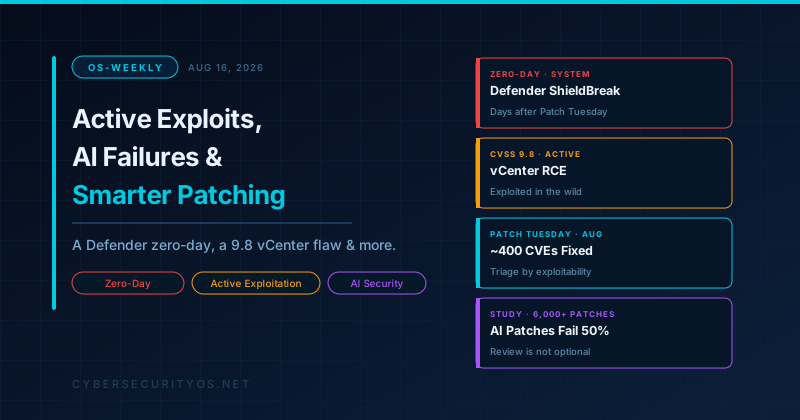
It was a loud week for patching discipline. A brand-new Microsoft Defender zero-day landed days after Patch Tuesday, attackers are already chaining a critical VMware vCenter flaw in the wild, and August’s update deluge is a reminder that raw CVE counts aren’t a triage strategy. Add in a new tool for spotting who’s tracking you online and a look at why security budgets keep climbing, and here’s what mattered this week.
Critical Threats & Breaches
A new Microsoft Defender zero-day, “ShieldBreak,” grants SYSTEM privileges

Threat actor group Nightmare Eclipse released a zero-day dubbed “ShieldBreak” targeting Microsoft Defender just days after Microsoft’s August 2026 Patch Tuesday — timing that suggests a deliberate move to exploit the window between “patched” and “actually deployed.” Successful exploitation grants an attacker SYSTEM-level privileges, effectively full control of the affected host.
This is a textbook example of why patch cadence alone isn’t a defense strategy. Threat actors are increasingly timing new exploits to land right after major vendor updates, betting that most organizations haven’t finished rolling patches out yet. Layered defenses, endpoint monitoring, and rapid deployment processes matter more than the patch itself.
Attackers are actively exploiting a critical VMware vCenter flaw

CVE-2026-59310, a directory-traversal vulnerability in Broadcom’s VMware vCenter carrying a CVSS score of 9.8, is being actively exploited in the wild to execute arbitrary code on unpatched servers and gain persistent remote access. Patches have been available from VMware, but exploitation activity suggests a meaningful number of environments still haven’t applied them.
A 9.8 CVSS score paired with confirmed active exploitation is about as clear a “patch now” signal as it gets. If vCenter is anywhere in your infrastructure, this belongs at the top of this week’s remediation queue — not the bottom.
Microsoft’s August Patch Tuesday: prioritize by exploitability, not raw CVE count

Coverage of Microsoft’s August 2026 security update varied by source — Krebs on Security counted 398 vulnerabilities addressed (including one actively exploited flaw and two publicly disclosed prior to release), while other outlets put the total closer to 421, with 62 rated critical. Regardless of the exact tally, the consistent message from researchers this month is the same: prioritize by exploitability and exposure, not by CVE count.
A 400-vulnerability update is not a to-do list to work through top-to-bottom. Effective patch management means triaging for actively exploited and publicly disclosed issues first, then working outward from there — and honestly, that triage step is where most teams lose the week. We’ve been running our own phish-report and IoC-enrichment pipelines through Make, a visual workflow-automation tool that handles lookup, dedupe, and alerting without babysitting a cron job. Affiliate link — signing up may support CyberShield at no extra cost to you.
Industry & Policy
A new free tool reveals who’s tracking you online

A new free tool called DecryptAds scrapes and correlates adtech data to reveal which companies are serving ads on a given website or pulling data from a mobile app — information that was previously semi-public at best, buried inside opaque advertising platforms.
Tools like this are useful both for personal privacy hygiene and for understanding third-party data flows when assessing an organization’s web or app attack surface and vendor exposure.
Why cybersecurity costs keep climbing

A look at why security budgets keep climbing: increasingly sophisticated threats, rising cyber-insurance premiums, and tightening regulatory requirements are all pushing spend upward across both private and public sectors.
Rising security budgets generally track with rising headcount and hiring demand — a useful macro signal if you’re timing a move into the field or trying to build a track record while you wait for the right opening. I use Hypefury to queue posts and resurface write-ups automatically, which keeps a public presence going even during weeks buried in patch notes. Affiliate link — signing up may support CyberShield at no extra cost to you.
That’s the week. Patch what’s actively being exploited, triage by exposure, and keep an eye on where the budget — and the hiring — is headed. Follow CyberShield for the next digest, and stay sharp out there.