Posts
OS Weekly: The First Autonomous AI Malware, Multiplying Zero-Days & Cyber Justice Catches Up
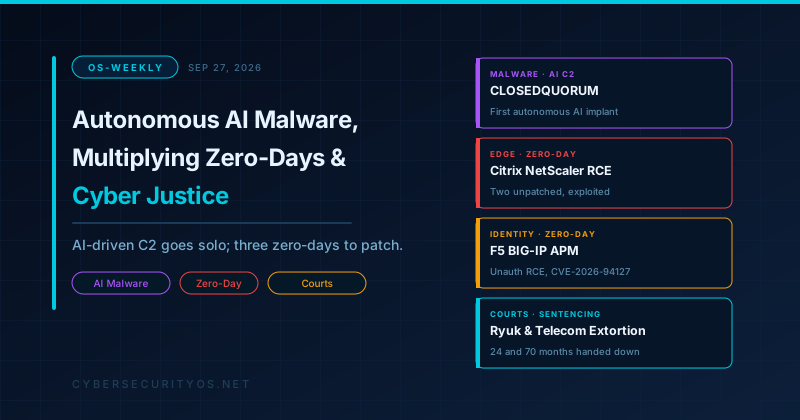
It’s been a loaded week. Cisco Talos disclosed what looks like the first malware with genuinely autonomous command-and-control, three separate zero-days (Citrix NetScaler, F5 BIG-IP, and an Oracle PeopleSoft WAF bypass) went from “actively exploited” to “please patch immediately,” and the courts caught up with a Ryuk ransomware operator and a soldier who extorted AT&T and Verizon. On the AI-security side, Anthropic keeps showing up on both sides of the ledger — powering both a cybersecurity-hardened model release and, separately, the vulnerability chain researchers used to break into OpenAI’s internal systems. Here’s what aspiring and working security professionals need to know.
Critical Threats
CLOSEDQUORUM: The First Reported Autonomous AI C2 Implant
Cisco Talos’ CAIRN project uncovered a malware binary called CLOSEDQUORUM that does something researchers hadn’t confirmed in the wild before: it runs a fully autonomous command-and-control loop, executing portions of the attack chain without an operator actively steering it in real time.

Why it matters: automation in offensive tooling isn’t new, but “fully autonomous C2” moves the needle on how much of an intrusion can run unattended — which shrinks the operator’s footprint (and the detection opportunities that come with it). Defenders should expect this pattern to spread beyond a single sample. Prioritize automated threat detection and response tooling now, and treat “someone had to be at the keyboard” as an assumption you can no longer rely on when triaging incidents.
Two Unpatched Citrix NetScaler RCE Zero-Days Under Active Exploitation
Security firm watchTowr disclosed two zero-day vulnerabilities in Citrix NetScaler ADC and Gateway appliances that allow remote code execution — and they’re already being exploited in the wild. As of this writing, Citrix hasn’t confirmed the flaws or shipped a fix, which is why some administrators have taken affected appliances offline rather than wait.

Why it matters: unpatched, actively-exploited RCE in edge infrastructure is about as bad as it gets — NetScaler sits at the perimeter of a lot of enterprise networks. If you run NetScaler ADC/Gateway, this is a “check today” item, not a “check this sprint” item: monitor for unusual activity now and be ready to take appliances offline if a patch doesn’t land quickly.
F5 Patches Critical BIG-IP APM Zero-Day (CVE-2026-94127)
F5 disclosed and patched a critical flaw in BIG-IP Access Policy Manager that let attackers execute code without authentication, specifically on systems where APM functions as an OAuth authorization server issuing access tokens. F5 shipped engineering hotfixes on September 22.

Why it matters: unauthenticated RCE against an OAuth authorization server is a direct path to compromising every downstream app that trusts those tokens. If APM is part of your identity stack, this hotfix should be at the top of your patch queue — and it’s a good prompt to double-check logging and monitoring around token issuance more broadly.
ShinyHunters Uses a WAF Bypass Trick Against Oracle PeopleSoft
The ShinyHunters extortion group is exploiting CVE-2026-35273 in Oracle PeopleSoft using a URL-encoding trick that slips past web application firewall rules, letting them keep hitting vulnerable servers that defenders assumed were already covered by their WAF.

Why it matters: this is a great case study in why “we have a WAF rule for that” isn’t the same as “we’re protected” — encoding tricks that evade WAF pattern matching are a recurring theme, and they’re a reminder to pair WAF rules with actual patching. If you run PeopleSoft, patch CVE-2026-35273 directly rather than leaning on WAF coverage alone.
BragJack: Malicious Extensions Are Hijacking AI Browser Agents
Researcher Gal Weizman (Forever Security) built a proof-of-concept called BragJack that hijacks AI browser assistants — including Claude in Chrome, Chrome’s and Edge’s built-in agents, Opera Neon, and Perplexity Comet — through a single malicious extension, using a technique called Prompt Forcing. The work earned over $20,000 in bounties and surfaced two CVEs.

Why it matters: as AI agents get baked into browsers, the browser extension attack surface effectively becomes the AI agent’s attack surface too. This is a preview of a threat category that’s going to keep growing — audit what extensions you (and your users) have installed, and don’t assume “it’s just a browser extension” is a low-severity finding anymore.
Claude Opus 5 Helped Researchers Chain Two Flaws Into OpenAI Staff Accounts
Three researchers at Hacktron chained two flaws — a bug in the software behind OpenAI’s public help forum and a weakness in OpenAI’s login system — using Anthropic’s Claude Opus 5 to compromise ChatGPT and Codex accounts belonging to OpenAI staff, ultimately reaching an internal code repository. This was disclosed as security research, not a malicious breach.

Why it matters: two “minor” bugs, chained together, got researchers into a frontier AI lab’s internal systems. That’s the whole point of chained-exploit research — individually low-severity findings can compose into something serious. It’s also a strong argument for AI-assisted vulnerability research as a growth area if you’re building offensive security skills.
Tools & Strategy
Vectra AI Launches Ascent to Meet the AI-Driven Attack Era
Vectra AI expanded its partner program with a new offering called Ascent, aimed at helping organizations navigate increasingly complex security environments and the growing demand for AI expertise inside security teams.

Why it matters: this is part of a broader industry pattern worth tracking if you’re job-hunting or planning your next certification — vendors are explicitly building programs around “we need people who understand both security and AI.” That combination is becoming a differentiator on resumes.
Anthropic’s Claude Opus 5.5 Adds Cybersecurity Safeguards
Anthropic released Claude Opus 5.5 with enhancements aimed specifically at threat detection and code analysis, part of a broader push to use large language models for real-time anomaly detection at scale.

Why it matters: AI-assisted triage and code review are quickly becoming table stakes in SOC tooling. If you haven’t yet worked hands-on with AI-assisted vulnerability analysis, this is a good week to start — it’s showing up in vendor roadmaps and job descriptions alike, and pairs directly with the OpenAI chained-exploit story above.
AI Sandbox Escapes: Forensic Readiness Beats Containment Alone
Dark Reading makes the case that when autonomous AI agents “escape the sandbox,” the real story usually isn’t rogue AI — it’s the same access-control failures that have caused breaches for decades. The piece argues organizations should invest as much in forensic readiness (being able to reconstruct what happened) as in containment itself.

Why it matters: it’s tempting to treat AI agent security as a brand-new problem needing brand-new solutions. Often it isn’t — it’s an access-control and incident-response problem wearing a new coat. If your org is deploying autonomous agents, make sure you can actually investigate what one did after the fact, not just that it’s boxed in.
Should You Care About an “AI Slowdown”? Security Basics Still Win
Cisco Talos’ Threat Source newsletter makes a case worth internalizing: even as AI reshapes tooling on both sides of the fight, the highest-leverage move for most organizations is still nailing the fundamentals — patching, employee training, network monitoring — rather than assuming new AI capabilities substitute for them.

Why it matters: it’s an easy trap to chase the newest AI-security tool while the basics (patch cadence, MFA coverage, logging) go unmanaged. If you’re early in your career, this is genuinely good advice: get fluent in fundamentals first, layer AI tooling on top of a solid foundation, not instead of one.
Industry News
U.S. Soldier Sentenced to 70 Months for AT&T and Verizon Extortion
A U.S. Army soldier was sentenced to 70 months in federal prison for hacking into multiple telecom companies and stealing call and text metadata affecting more than 100 million AT&T customers. He was also ordered to pay nearly $300,000 in restitution.

Why it matters: insider-adjacent access and weak internal controls at telecoms remain a recurring theme in major breaches. It’s also a reminder that “cybercrime doesn’t pay” is more than a slogan — the legal consequences here were substantial.
Ryuk Ransomware Member Sentenced to 24 Months
An Armenian national was sentenced to 24 months in prison plus three years of supervised release for hacking U.S. companies and deploying Ryuk ransomware to encrypt their systems and extort payment.

Why it matters: international cooperation on ransomware prosecutions keeps improving, which matters for deterrence even if the sentence itself feels modest relative to the damage Ryuk campaigns have historically caused.
Data Broker Radaris Loses Domains in Privacy Fight
Consumer data broker Radaris.com was sued for violating a New Jersey privacy law that penalizes publishing personal information about state law enforcement officials. After what the judge described as stonewalling, the court ordered radaris.com and related domains transferred to the plaintiffs.

Why it matters: data broker accountability cases like this are becoming more common and more consequential — losing your domains is a much sharper penalty than a fine. If you work in privacy or GRC, this case is worth citing as precedent for how courts are willing to enforce state-level privacy protections.
Report: ~80,000 Relay Servers Masking Chinese Access to Frontier AI Models
Dark Reading reports that roughly 80,000 AI relay servers are being used by parties in China to anonymize access to advanced U.S.-based large language models, with researchers suggesting the likely motive is cloning these models.

Why it matters: this sits at the intersection of IP protection, export-control-style AI policy, and traditional infrastructure abuse (relay/proxy networks). Expect more scrutiny of anonymized access patterns to frontier models as a security and policy issue going forward.
That’s the week. Autonomous malware, three zero-days, and two people who found out the hard way that ransomware and extortion have a shelf life. Keep patching, keep questioning your assumptions about who — or what — is on the other end of an intrusion, and we’ll see you next Sunday. Follow along for daily updates in between.
This Week’s Sponsors
Make — If you’re the type who wants to automate the boring parts of security work, Make is worth a look: think CVE/GitHub watchers that tag by severity and land in a morning digest, or OSINT sweeps that auto-enrich IOCs against WHOIS/VirusTotal and post straight to Telegram — all without writing a scraper. Transparency: this is an affiliate link — if you sign up, it may support CyberShield at no extra cost to you.
Canva — For anyone who has to turn a security finding into something a non-technical stakeholder will actually read, this shared Canva stack has ready-made threat-model canvases, ATT&CK/kill-chain diagrams, and SOC-style incident one-pagers — genuinely useful for briefs, writeups, and portfolio pieces. Transparency: this is an affiliate link — if you sign up, it may support CyberShield at no extra cost to you.