Posts
SPECTRA: AI-Powered Vulnerability Triage That Actually Works for Security Teams
Security teams are not losing the fight because of bad tools. They’re losing it because of volume.
In 2025, 131 new CVEs were disclosed every single day — up from 113 per day the year prior. Meanwhile, the global cybersecurity workforce gap has reached 4.8 million unfilled positions, and budget cuts — not lack of talent — are now the primary driver of security team understaffing. The signal is buried in the noise, and analysts spend more hours normalizing scanner outputs and writing summaries than actually remediating risk.
This is the problem SPECTRA was built to solve.
What Is SPECTRA?
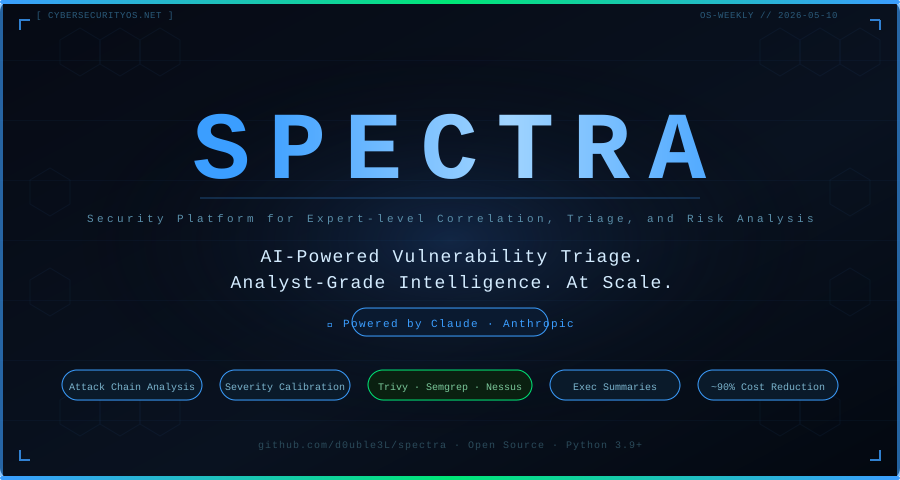
SPECTRA — Security Platform for Expert-level Correlation, Triage, and Risk Analysis — is an open-source, AI-powered CLI that sits downstream of your existing security scanners and transforms their raw output into something your team can actually act on.
It doesn’t replace your scanners. It makes them useful at scale.
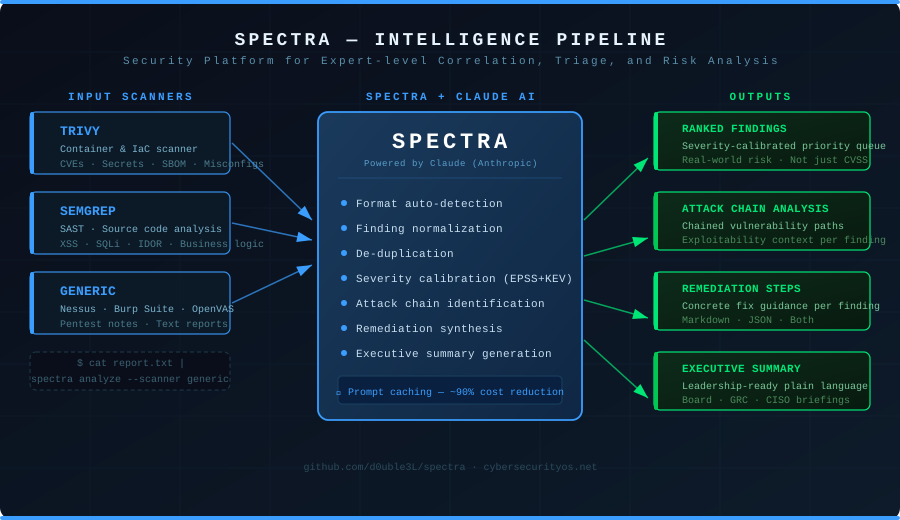
Powered by Claude, SPECTRA ingests output from Trivy, Semgrep, and generic scanners (Nessus, Burp Suite, pentest notes), then applies AI-driven analysis to produce:
- Ranked findings — calibrated by real-world severity, not just CVSS scores
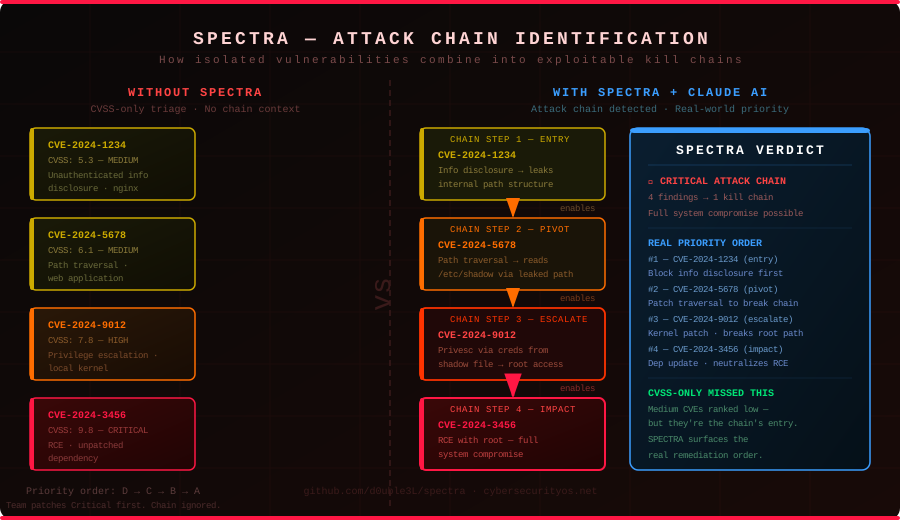
- Attack chain analysis — connecting related vulnerabilities into exploitable paths
- Executive summaries — plain-language overviews ready for leadership briefings
- Concrete remediation steps — not “patch this CVE,” but how, where, and why
A single command. Analyst-grade output.
# Analyze a Trivy container scan
spectra analyze trivy.json --format both --output reports/run1 --usage

# Pipe Semgrep output directly
cat semgrep_output.json | spectra analyze --scanner semgrep --format json --output reports/pr-check
Already curious about how Claude fits into security workflows more broadly? See my earlier post: Claude AI Use Cases for Security Teams and Startups in 2026.
The Real Cost of Manual Vulnerability Triage
The traditional vulnerability management workflow looks like this:
- Run scanner across environment
- Export findings — often hundreds per scan, per tool
- Analyst manually reviews and triages
- Write severity-ranked summary for leadership
- Assign remediation tickets
- Repeat for every scanner, every environment, every sprint
Step 3 is where teams lose weeks. But the data behind that bottleneck is more alarming than most leaders realize.
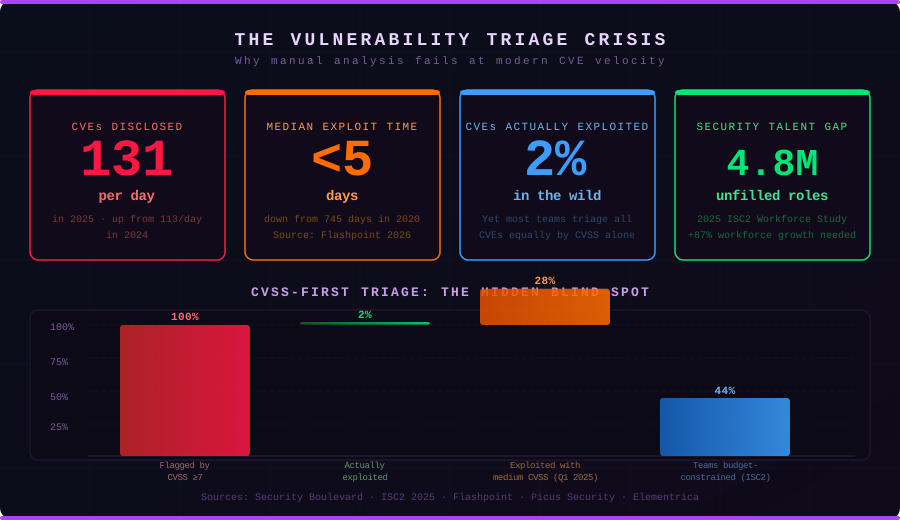
The numbers that should concern every security leader:
- Only ~2% of published CVEs are ever exploited in the wild — yet most teams still triage by CVSS score, which flags all of them equally
- In Q1 2025, 28% of exploited vulnerabilities carried only medium CVSS base scores — meaning CVSS-first teams are systematically deprioritizing vulnerabilities attackers are actively using
- The median time to exploit a newly disclosed vulnerability is now under 5 days — down from 745 days in 2020
- Organizations with significant security staff shortages face breach costs $1.76 million higher than their well-staffed counterparts
Manual triage at the current CVE velocity isn’t a process problem. It’s a physics problem. The math doesn’t work without AI-assisted analysis in the loop.
Why CVSS Scores Alone Are Broken — and What SPECTRA Does Instead
The industry’s over-reliance on CVSS is well-documented. CVSS measures theoretical severity, not contextual risk. It doesn’t know whether your firewall blocks the exploit path, or whether your EDR catches the lateral movement technique that chains a medium-severity CVE into a critical attack path.
Modern prioritization frameworks like EPSS (Exploit Prediction Scoring System) and the CISA Known Exploited Vulnerabilities (KEV) catalog add contextual signal — but they still require a human analyst to synthesize them into a remediation order.
SPECTRA applies AI reasoning across all of these dimensions simultaneously. Rather than sorting by score, it evaluates:
- Which findings are chained — and whether those chains form exploitable attack paths
- Whether a finding’s context in your environment elevates or reduces its actual risk
- How to communicate the findings at the right level for each audience (engineer vs. CISO vs. board)
This is the kind of analysis that previously required a senior analyst with deep context. SPECTRA makes it reproducible and scalable.
SPECTRA in Practice: Four Security Use Cases
1. Vulnerability Management Programs
For teams running regular scan cycles across cloud infrastructure or CI/CD pipelines, SPECTRA compresses triage time from hours to minutes. Findings come back ranked, contextualized, and prioritized — your team starts at remediation, not at sorting. The output is consistent across analysts, removing the institutional knowledge dependency that plagues manual triage workflows.
2. DevSecOps and Shift-Left Integration
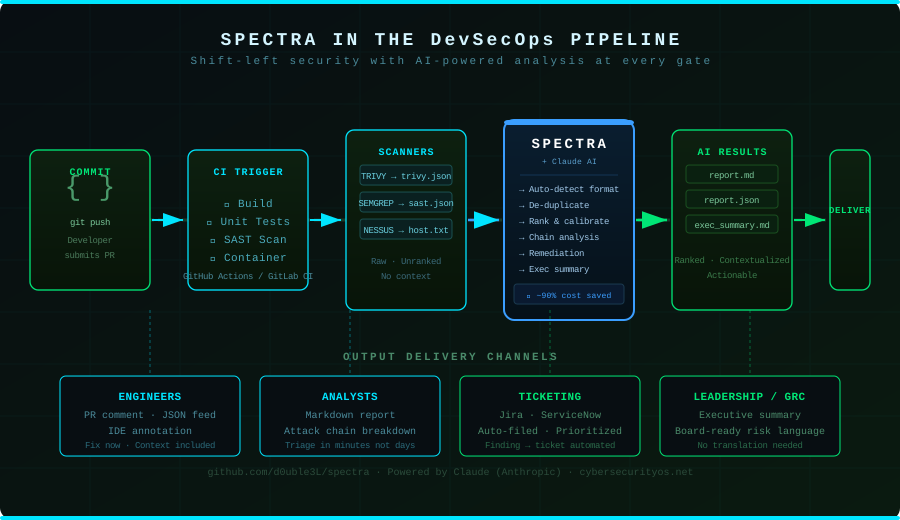
SPECTRA’s CLI-first design makes it a natural fit in pipelines. Wire it into your PR checks or nightly build jobs and engineers receive AI-summarized security findings alongside their build results — without waiting on a security analyst to manually review.
cat semgrep_output.json | spectra analyze --scanner semgrep --format json --output reports/pr-check
This is what shift-left security looks like when it actually scales. Semgrep surfaces the raw SAST findings; SPECTRA tells you which ones to act on and in what order. Trivy scans your container layers; SPECTRA tells you what those CVEs mean for your specific risk posture.
If you’re building toward a DevSecOps culture, SPECTRA closes the loop between finding and prioritization without adding analyst headcount.
3. Red Team and Penetration Testing Workflows
Generic scanner support means SPECTRA works with unstructured pentest notes, Burp Suite exports, or any text-based security report. A consultant can feed raw findings into SPECTRA and receive a structured, severity-ranked summary — reducing report-writing time and enforcing consistency across engagements. For pentest teams managing multiple simultaneous assessments, this is a meaningful force multiplier.
4. GRC and Leadership Reporting
The executive summary output is one of the most underappreciated features. Security teams consistently struggle to translate technical findings into business risk language that leadership can act on. SPECTRA performs that translation automatically, producing plain-language summaries suitable for board-level briefings, GRC audits, or regulatory reporting — without the analyst having to write a separate report for every audience.
The Architecture Behind the Intelligence
Prompt Caching: What Makes the Economics Work
SPECTRA uses Claude’s prompt caching — the analyst system prompt is cached after the first call, making repeated analyses approximately 90% cheaper on subsequent runs. For teams running SPECTRA continuously in pipelines, this isn’t a minor optimization — it’s what makes AI-assisted security analysis economically viable at production scale.
Flexible Output: Markdown and Structured JSON
SPECTRA outputs both human-readable Markdown and structured JSON. This means it integrates cleanly into existing workflows — ticketing systems, SIEM dashboards, GRC platforms — without requiring platform migration. You’re not adopting a new vendor ecosystem. SPECTRA augments the stack you already have.
Docker-Ready Deployment
No complex setup. Mount your scan files, get reports back:
docker compose run --rm analyze scans/trivy.json --format both --output /app/reports/out
Supported Scanners
| Scanner | Format | Auto-detect |
|---|---|---|
| Trivy | JSON | ✓ |
| Semgrep | JSON | ✓ |
| Nessus / OpenVAS | Text | via --scanner generic |
| Burp Suite | Text export | via --scanner generic |
| Pentest notes | Plain text | via --scanner generic |
Claude as the Intelligence Layer
Anthropic’s investment in security-specific AI capabilities is worth understanding as context for what SPECTRA is built on. In early 2026, Anthropic launched Claude Security — a public beta that uses Claude to scan codebases for vulnerabilities, reason across file dependencies, trace data flows, and generate targeted patch instructions. Shortly after, Anthropic unveiled Claude Mythos Preview, a frontier model that identified thousands of previously unknown zero-day vulnerabilities across major operating systems and browsers.
The same reasoning capabilities that power those Anthropic-native tools — contextual vulnerability analysis, attack chain identification, audience-appropriate communication — are what SPECTRA brings to your scanner output pipeline, accessible via a simple CLI.
Security as a First-Class Concern
The philosophy behind SPECTRA reflects a pattern I keep coming back to: the best security tooling removes friction rather than adding it.
Most security tools are built for security teams in isolation. SPECTRA is built for how modern organizations actually operate — where developers own their services, pipelines move fast, and security teams are too small to manually review everything in their queue.
When AI-assisted triage is embedded directly into the development workflow, security stops being a gate at the end of the process and becomes a continuous, contextual signal throughout. That’s what secure-by-design looks like in practice — not just architecture decisions made at the whiteboard, but tooling that makes the secure path the frictionless path.
For a deeper look at how I think about AI embedded in security workflows, see: Claude AI Use Cases for Security Teams and Startups in 2026
What’s Next on the SPECTRA Roadmap
The current roadmap moves SPECTRA from a CLI utility toward a full security intelligence layer:
- REST API — platform-level CI/CD integration without CLI dependency
- Web UI — dashboard interface for analysts who need visual workflows
- Multi-scanner batch processing — run SPECTRA across an entire environment in one pass
- Jira / ServiceNow integration — close the loop from finding to remediation ticket automatically
- Trend analysis and risk scoring — track how your attack surface and risk posture change over time
- Full SecOps dashboard — aggregate views for security leadership and GRC reporting
Each step brings SPECTRA closer to operationalizing AI-assisted security at the program level, not just the individual scan level.
Getting Started with SPECTRA
SPECTRA is open source and runs anywhere Python 3.9+ is available.
GitHub: github.com/d0uble3L/spectra
git clone https://github.com/d0uble3L/spectra
cd spectra
pip install -e .
cp .env.example .env
# Add your Anthropic API key to .env

spectra analyze tests/samples/trivy_sample.json
Bring your own scanner. Bring your own output. SPECTRA handles the analysis.
The Bottom Line
Security teams don’t have an intelligence problem — they have an intelligence-at-scale problem.
The scanner data has always been there. The CVEs were always being disclosed. The vulnerabilities were always chaining together into exploitable attack paths. What was missing was a way to synthesize all of it, at volume, in real time, without a team of senior analysts reviewing every finding by hand.
SPECTRA is what happens when you apply modern AI to that constraint. Faster triage. Better prioritization. Findings that communicate clearly to engineers, analysts, and leadership — automatically.
Check out the project on GitHub and start turning your scanner noise into signal.
References and Further Reading
- SPECTRA on GitHub
- Claude AI Use Cases for Security Teams and Startups in 2026 — CybersecurityOS
- 46 Vulnerability Statistics 2026 — Security Boulevard
- 2025 ISC2 Cybersecurity Workforce Study
- Vulnerability Prioritization: Why CVSS Isn’t Enough — Picus Security
- N-Day Vulnerability Trends: The Shrinking Window — Flashpoint
- Anthropic Claude Security — Public Beta
- Anthropic Unveils Claude Mythos — SecurityWeek
- Trivy Open Source Vulnerability Scanner
- Semgrep SAST Platform
- CISA Known Exploited Vulnerabilities Catalog
- FIRST EPSS — Exploit Prediction Scoring System
- Why CVSS Scores Often Fail to Reflect Real-World Risk — Elementrica