Posts
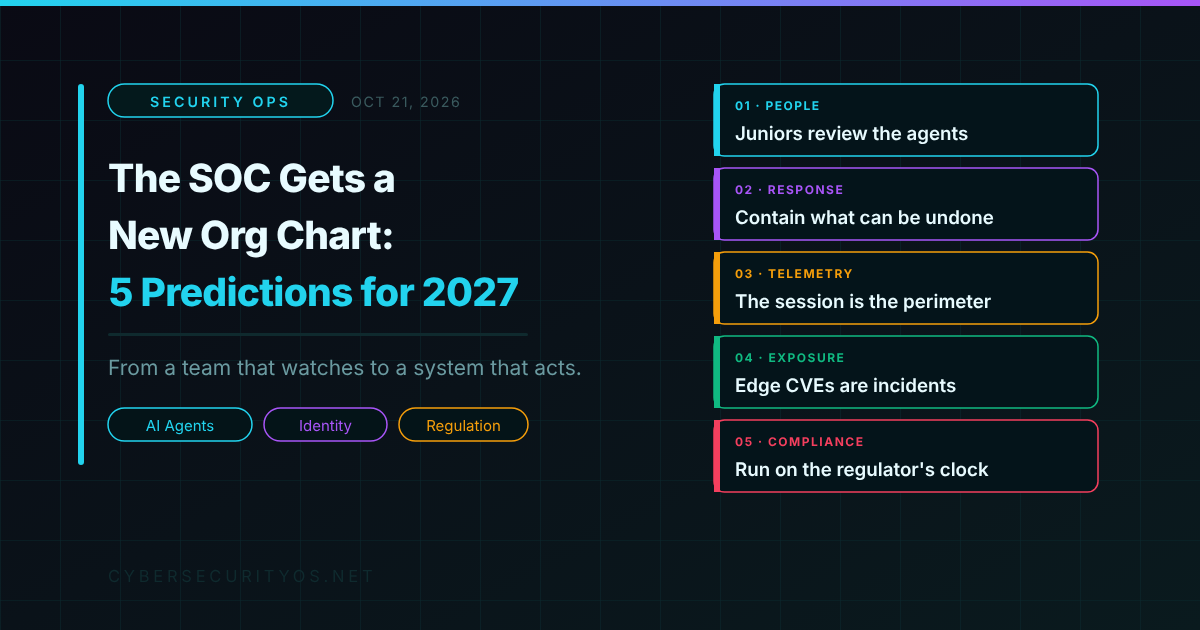
The SOC Gets a New Org Chart: Five Security Operations Predictions for 2027
Last week I argued that the bottleneck in detection engineering moved from writing rules to investigating alerts. If you missed it, start with The Bottleneck Moved: Detection Engineering Heading Into 2027.
This post zooms out to the whole SOC. Detection is one function. Security operations is the system around it: who triages, who acts, what telemetry matters, what the SOC owns, and whose clock it runs on.
All five of those are changing at once. By the end of 2027, a lot of SOCs will have a different org chart than the one on the wall today.
Here’s how I’m framing these. Each prediction is specific enough to be wrong. Each comes with a confidence level, a position I expect pushback on, and something you can do about it now. I’ll score them in December 2027.
1. The Tier 1 Queue Goes to Machines, Not the Tier 1 Job
The prediction: By the end of 2027, a major workforce study (ISC2’s or a comparable one) will report that AI triage is directly reducing hiring for entry-level SOC roles.
The direction is already set. Gartner predicts that by 2028, 70% of large SOCs will pilot AI agents to augment Tier 1 and Tier 2 operations. Agents are good at the first pass: pull the context, check the obvious benign explanations, and close or escalate. That’s most of what a Tier 1 analyst does on a normal shift.
So the queue moves. The question is what happens to the people.
The tempting answer is to cut the tier and bank the savings. That’s a mistake with a delayed bill. Every senior incident responder you have today learned the job by working a queue. They saw a thousand benign alerts, so they recognized the one that wasn’t. Remove the queue and you remove the apprenticeship. In five years you’ll have agents that need supervising and nobody with the instincts to supervise them.
My position: Don’t eliminate the junior tier. Redesign it. The new Tier 1 job is reviewing agent decisions. A junior analyst who audits 50 agent closures a day, and has to explain which ones were wrong and why, learns faster than one who clicks through 50 alerts. They also produce the quality data you need to trust the agent. Gartner’s same prediction says only 15% of those SOCs will see measurable improvement without structured evaluation. Juniors reviewing agent decisions is that evaluation.
What to do now: Before you change headcount, write down how your next generation of senior responders will be trained. If the answer is “we’ll hire them from somewhere else,” so will everyone else.
Confidence: 70%.
2. Containment Goes Autonomous, Where It Can Be Undone
The prediction: In 2027, autonomous response for reversible identity actions (revoking sessions, forcing reauthentication, suspending a risky OAuth grant) will be an on-by-default capability in at least two major XDR or identity security platforms, and “time to contain” will replace MTTR as the headline metric in at least one major vendor incident report.
Mandiant’s M-Trends 2026 puts the median handoff between initial access and the next threat actor at about 22 seconds. No human approval workflow runs in 22 seconds. If containment waits for a person to read the alert, open a ticket, and get sign-off, the attacker has already moved.
Most SOCs gate automated response on confidence. “Auto-contain when the model is 95% sure.” That’s the wrong dial. Confidence scores are hard to calibrate and easy to game. A better line is reversibility.
Revoking a session is cheap to undo. The user signs in again. Isolating one laptop is annoying, not catastrophic. Disabling a CFO’s account during quarter close, wiping a device, or blocking a production service account can do more damage than the attacker. Those need a human.
My position: Draw the automation line by blast radius and reversibility, not by model confidence. If an action can be undone in under five minutes with little business impact, it should not be waiting in a queue.
What to do now: List your top ten containment actions. Score each one on how easy it is to reverse and what it breaks. The cheap, reversible ones are your first autonomous playbooks. Get business sign-off on them now, in writing, while nothing is on fire.
Confidence: 65%.
3. Identity Becomes the SOC’s Primary Telemetry
The prediction: The 2027 editions of at least two major breach reports (Verizon DBIR, M-Trends, or comparable) will break out stolen sessions or tokens, or abuse of non-human identities, as a distinct and growing initial access category.
Exploitation is still the most common way in (more on that below). But identity is where attackers persist, spread, and increasingly start. M-Trends 2026 has voice phishing as the second most common initial access vector, at 11% of cases where a vector was identified. Verizon’s 2026 DBIR found that half of the ransomware victims with a prior infostealer or credential leak event had that event within 95 days of the attack.
An infostealer lifts a session cookie and replays it, and MFA never fires. A consent-phishing link gets an OAuth grant that survives a password reset. A caller talks the help desk into resetting MFA, the Scattered Spider playbook. A leaked API key or overprivileged service account gives standing access with no human behind it at all. If that last one is new to you, start with Non-Human Identity 101.
None of these show up well in endpoint or network telemetry. They show up in identity provider logs, SaaS audit logs, and cloud control-plane events. In a lot of SOCs, those are still second-class sources: ingested late, parsed badly, and owned by a different team.
My position: MFA is no longer the finish line. The session is the new perimeter. A SOC that can tell you every malicious process on a laptop but can’t tell you which sessions are live for a compromised user is defending the wrong layer.
What to do now: Pick one high-value user. Can your SOC answer, in under ten minutes, every active session, token, and OAuth grant that user has, across your identity provider and your top five SaaS apps? If not, that’s your 2027 telemetry roadmap.
Confidence: 75%.
4. The SOC Absorbs Exposure Response at the Edge
The prediction: Exploitation will hold the top initial access spot in both M-Trends 2027 (a seventh straight year) and the 2027 Verizon DBIR (a second straight year).
The two biggest breach datasets now agree. M-Trends 2026 has exploitation as the top initial access vector for the sixth year running, at 32%. Verizon’s 2026 DBIR has exploitation overtaking credential abuse for the first time, at 31% of breaches, up from 20% the year before. And the edge is where it concentrates. Verizon’s 2025 DBIR found edge devices and VPNs were the target in 22% of exploitation-related breaches, up from 3% the year before, with a median of 32 days to fully remediate those flaws.
A month is a long time when exploitation starts within days of disclosure, and sometimes before it. That gap used to belong to vulnerability management. It doesn’t anymore. When a critical VPN flaw drops, the real questions are SOC questions. Are we exposed? Were we already hit? What can we detect or block before the patch lands?
My position: The first 72 hours after a critical edge-device CVE is an incident, not a patching ticket. Treat it like one: an incident commander, a compromise assessment, temporary mitigations, and a hunt for signs of earlier exploitation. Patching closes the door. It doesn’t tell you who already walked through it.
What to do now: Write an “edge CVE” runbook before you need it. Include how you’ll confirm exposure, which logs prove or rule out exploitation, what you’ll do if the device’s own logs can’t be trusted, and who can approve taking it offline.
Confidence: 70%.
5. Regulatory Clocks Set the SOC’s Pace
The prediction: At least one EU financial regulator will announce an enforcement action or fine in 2027 that cites a failure in DORA’s ICT incident reporting requirements.
The clocks are already running. The SEC requires a Form 8-K within four business days of deciding a cybersecurity incident is material. NIS2 requires an early warning within 24 hours of becoming aware of a significant incident. DORA requires an initial notification within four hours of classifying an ICT incident as major, and no later than 24 hours after becoming aware of it.
DORA has applied since January 2025. Supervisors spent the first stretch building reporting channels and getting reports in. In June 2026 the European Supervisory Authorities published their first annual report on major ICT incidents: 3,383 reported across the EU financial sector in 2025. As of this writing, no supervisor has announced a fine for getting those reports wrong. The next stretch is checking whether those reports were on time and accurate. Enforcement tends to follow that sequence.
This changes what the SOC produces. The case record is no longer an internal working file. It’s evidence of what you knew, when you knew it, and when you decided. “We weren’t sure it was material yet” holds up only if the timeline shows a real, documented assessment, not a ticket that sat untouched over a weekend.
My position: Materiality and classification decisions belong in the incident timeline, with timestamps and named owners, from the first hour. If legal and the SOC each keep their own version of the timeline, you have two timelines, and a regulator will find the gap between them.
What to do now: Run a tabletop where the only goal is to hit the reporting clock. Start the timer at the first alert. See how long it takes to reach a defensible classification decision and a draft notification. Most teams find the delay isn’t the investigation. It’s figuring out who decides.
Confidence: 60%.
The Scorecard
| # | Prediction | How we’ll check in December 2027 | Confidence |
|---|---|---|---|
| 1 | AI triage reduces entry-level SOC hiring | ISC2 or comparable workforce study | 70% |
| 2 | Autonomous reversible identity containment ships on by default | Major XDR/identity platform releases | 65% |
| 3 | Session, token, or NHI abuse broken out as its own access vector | 2027 DBIR, M-Trends, or comparable reports | 75% |
| 4 | Exploitation stays the top initial access vector in both reports | M-Trends 2027 and 2027 DBIR | 70% |
| 5 | First enforcement action citing DORA incident reporting | EU supervisor announcements | 60% |
The Leader Lens
Read the five together and there’s one theme: the SOC is turning from a team that watches into a system that acts. Machines take the first pass and the first containment step. People move up a level to supervise, decide, and own the irreversible calls. And the whole thing runs on clocks set by attackers and regulators, not by your shift schedule.
That shift needs a different budget conversation. “We need more analysts” is a losing argument in 2027. Try this instead. Technical fact: our containment depends on a human approving every action. Business risk: attackers hand off access in seconds, and our approval step takes hours. Business impact: a contained intrusion turns into a reportable incident with a regulatory clock attached. Now you’re asking for funding to shrink a risk the board already understands. For the metrics that support that conversation, see Security KPIs That Actually Matter.
Monday Morning
For practitioners:
- Score your top ten containment actions for reversibility and blast radius. Mark the ones that could safely run without a human.
- Time how long it takes to list every live session and OAuth grant for one user. Write the number down.
- Draft the edge CVE runbook. One page is enough to start.
For leaders:
- Write the training plan for your next generation of senior responders before you change Tier 1 headcount.
- Get business sign-off on a first set of autonomous, reversible containment actions.
- Run a reporting-clock tabletop with legal in the room, and find out who actually makes the materiality call.
One Question
If your best analyst learned the job by working the queue, and the queue goes to an agent next year, how will your next best analyst learn it?
Get the next breakdown in your inbox. Subscribe to the CybersecurityOS newsletter for weekly practitioner breakdowns like this one.
Make your own call. Join the CybersecurityOS Telegram community and tell us which of these five you’d bet against, and what you’d predict instead.