Posts
AWS Security Agent: Continuous Penetration Testing and Threat Modeling for the AI Development Era
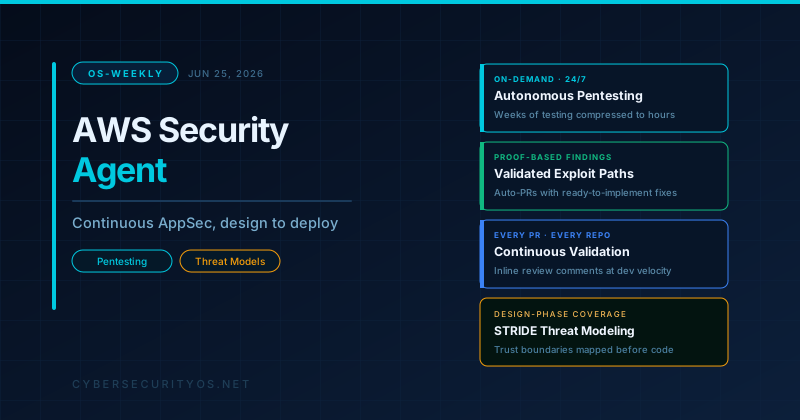
Most security programs are still built around a calendar, not a codebase. A pen test gets scheduled once or twice a year. A design review happens at a milestone meeting. By the time either one produces a finding, the application it was testing has already shipped four more releases.
That mismatch isn’t a staffing problem — it’s a structural one. AWS’s own teams have pointed out that more than 60% of organizations update their web applications weekly or more often, while nearly 75% test those same applications only monthly or less. Manual review simply can’t move at the speed code ships. AWS Security Agent is AWS’s answer to that gap — and it’s worth understanding regardless of which cloud you run on, because the underlying shift it represents is bigger than one vendor’s product.
What Is AWS Security Agent?
AWS Security Agent is a frontier AI agent, now part of AWS Continuum, built to secure applications continuously across the development lifecycle rather than at scheduled checkpoints. Instead of producing a static report once a quarter, it runs as an on-demand capability your team can invoke whenever a design changes, a pull request opens, or a release is about to ship.
Functionally, it does three things well: it plans and executes penetration tests against your application with real exploitation attempts, it builds threat models from your design documents and source code, and it runs security reviews on both architecture and code — all the way through finding, validating, and proposing a fix for what it discovers.
That “find, validate, fix” loop is the part that separates it from a traditional scanner. A scanner tells you something might be wrong. AWS Security Agent attempts to actually exploit the issue before it ever lands in your queue.
Key Capabilities
On-Demand Penetration Testing at Development Velocity
Traditional pen tests are scoped, scheduled, and staffed weeks in advance, then take weeks more to execute and report. AWS Security Agent deploys specialized AI agents that run continuously, compressing that timeline from weeks to hours by working around the clock rather than within a consultant’s billable schedule. You provide a target, credentials, and context — it starts testing on your timeline, not a vendor’s.
Validated Vulnerabilities, Not Just Findings
The agent doesn’t stop at “this endpoint looks vulnerable.” It attempts the exploit, confirms the result, and documents a reproducible attack path with an impact assessment. Coverage spans the OWASP Top 10 as well as business-logic flaws — the kind of issue that only becomes dangerous when several individually low-severity bugs get chained together (think: a moderate stored XSS that enables session hijacking that ultimately exposes database credentials). Because every finding is proof-based, teams spend their time on confirmed risk instead of triaging false positives, and each report ships with a ready-to-implement fix rather than a generic remediation checklist.
Continuous Validation at Scale
Security testing has historically been rationed to your highest-risk applications because human pentesters are a finite resource. AWS Security Agent can review every pull request as it opens and scan entire repositories on demand, so coverage stops being a budget decision and becomes the default across your whole portfolio — not just the handful of apps the security team had time for this quarter.
Context-Aware Testing Customized to Your Application
Generic vulnerability scanning treats every application the same. AWS Security Agent ingests your actual source code, API specifications, and design documentation to build an understanding of what your application does before it decides how to attack it — and it enforces your organization’s specific security requirements, not a generic checklist. Define your approved authentication libraries, logging retention policy, or data-handling rules once, and the agent checks every design and every pull request against those standards automatically.
Threat Modeling and Design/Code Security Reviews
Before a single line of code is written, AWS Security Agent can turn a design document into a structured threat model: a system overview of components, trust boundaries, and data flows, paired with threats categorized using the STRIDE framework (Spoofing, Tampering, Repudiation, Information Disclosure, Denial of Service, Elevation of Privilege) and ranked by severity. These models aren’t one-time artifacts — they’re reusable and re-runnable as the design evolves, so the threat model actually keeps pace with the architecture instead of going stale the week after the design review.
How It Fits Into the Developer Workflow
This is the part that determines whether a security tool actually gets used: does it live where developers already work, or does it require a context switch into a separate security console?
AWS Security Agent is built to integrate directly into existing tooling through Kiro, a Claude Code plugin, or an open MCP integration that works with any AI-powered IDE. In practice, that means a developer can trigger a threat model or a code security review inline, without leaving their editor. Connected repositories get automated pull request analysis, with findings posted as comments directly on the PR — so vulnerabilities surface at the exact moment they’re cheapest to fix, before a merge rather than after a deploy. And when it’s time to validate a release, the CLI lets you kick off a full penetration test from the command line before pushing to production, with API support for teams who want the same capability wired directly into a CI/CD pipeline.
Why This Matters
The headline shift here isn’t a new scanner — it’s a change in cadence. AWS Security Agent moves security coverage from design through deployment instead of bolting it on at the end, and it scales security expertise to match development velocity rather than asking developers to wait on a finite pool of human reviewers. That’s the real value: not “one more tool,” but a credible path toward closing the gap between how often applications change and how often they’re actually tested.
Getting Started
If you’re evaluating this for your own organization, the practical on-ramp looks like this:
- Define your security requirements once, centrally — approved libraries, logging standards, data access policies — so every review checks against your actual rules, not a generic baseline.
- Start at design time. Run a threat model against your architecture or scope documents before code is written, so structural issues get caught while they’re still cheap to change.
- Turn on PR-level review for your active repositories so findings show up as comments at merge time, not after release.
- Gate production deploys with a CLI- or API-triggered penetration test as part of your release process, rather than relying on the next scheduled annual engagement.
A Balanced Closing Thought
It’s worth being clear-eyed about what this kind of tooling is — and isn’t. AWS Security Agent and tools like it dramatically increase the frequency and coverage of security testing, and proof-based validation means engineers spend less time chasing unconfirmed findings. That’s a genuine improvement over the status quo.
But validated exploitation of a known vulnerability class is a different problem than judging novel business risk or the kind of contextual reasoning an experienced security professional brings to a high-stakes architecture decision. AI agents are extending how far and how often security coverage can reach — they aren’t yet a substitute for the human judgment that decides what to do with what they find. The teams getting the most out of this generation of tooling are pairing it with their existing review practices, not replacing them outright.
References / Further Reading
- AWS Security Agent — product page
- AWS Security Agent: On-Demand Penetration Testing Now Generally Available — AWS Security Blog
- New AWS Security Agent Secures Applications Proactively From Design to Deployment (Preview) — AWS News Blog
- AWS Security Agent Documentation — What Is AWS Security Agent?
💡 Want to lead with clarity in the AI era? If you’re aiming to lead a security team, break into cybersecurity, or operate with greater speed and confidence, this is the toolkit you’ve been missing: 🔗 Cybersecurity Leadership OS: Battle-Tested Mental Models for Clarity, Speed & Command