Posts
Top 5 Claude AI Use Cases for Startup Cybersecurity Teams in 2026
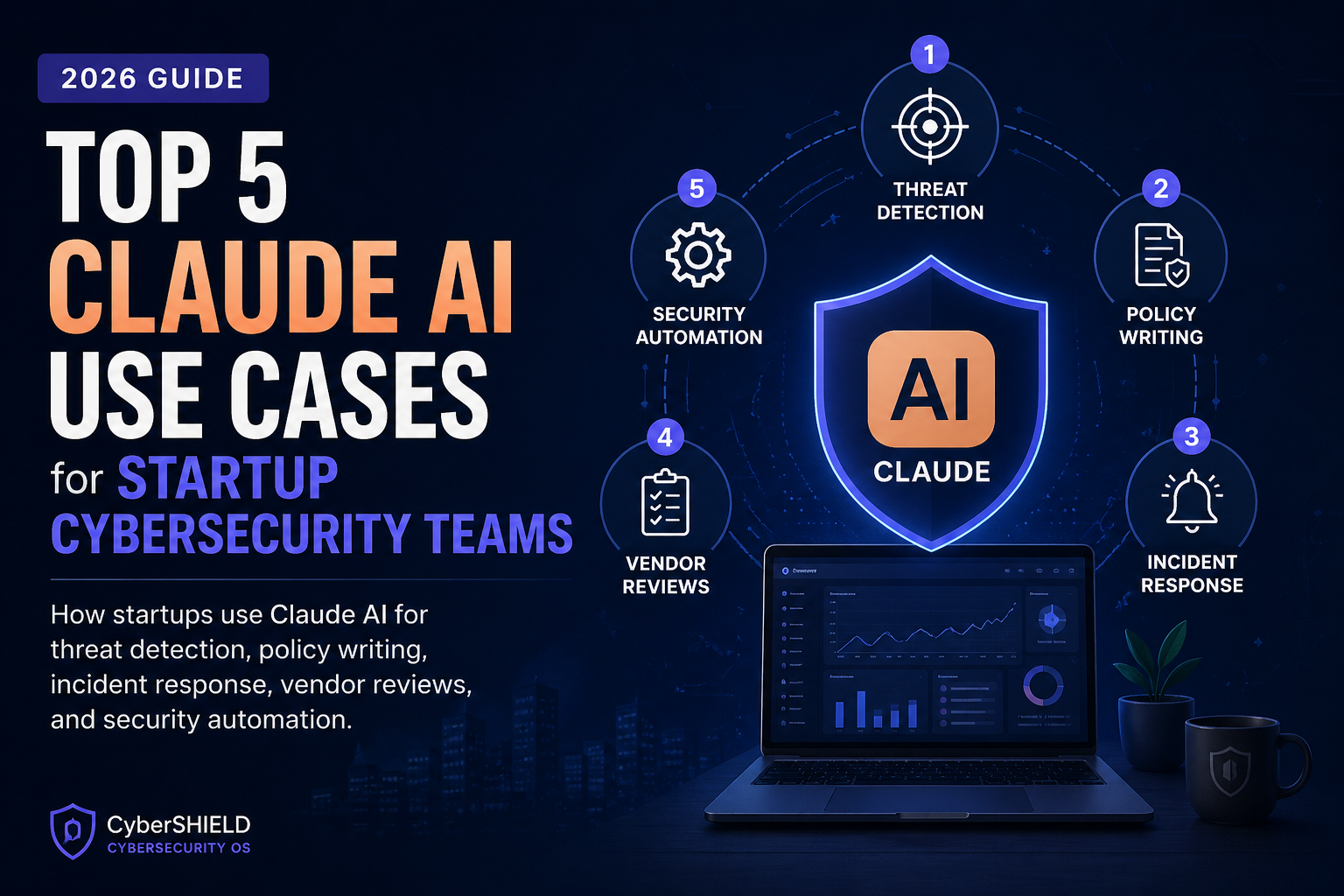
The cybersecurity landscape shifted dramatically in 2026. With the launch of Claude Code Security in February and the subsequent release of Claude Mythos Preview through Project Glasswing, AI-powered security is no longer a luxury reserved for enterprise teams with eight-figure budgets.
For startup security teams — often a single overworked engineer or a small group managing compliance, code review, vendor risk, and incident response simultaneously — Claude has become a genuine force multiplier. But the internet is full of surface-level takes on “AI for security.” This isn’t that.
What follows is a practitioner’s view of the five highest-impact ways startup security teams are deploying Claude right now — with enough technical specificity to actually get you started, and enough honesty about the tradeoffs to help you deploy it responsibly.
1. Vulnerability Detection and Code Security Scanning
Traditional static analysis tools — Semgrep, Bandit, CodeQL — pattern-match against known vulnerability signatures. They’re fast, they’re automatable, and they catch the obvious stuff: hardcoded secrets, deprecated crypto, missing input validation. What they miss is the subtle, context-dependent logic that actually gets exploited.
Claude reasons about code the way a senior security engineer does: it traces data flows, models trust boundaries, and asks “what happens if an attacker controls this input three call frames up?” According to Anthropic, Claude Code Security “reads and reasons about your code the way a human security researcher would: understanding how components interact, tracing how data moves through your application, and catching complex vulnerabilities that rule-based tools miss” — including broken access control (OWASP A01) and flawed business logic.

During internal testing, Claude Opus 4.6 identified over 500 previously unknown high-severity vulnerabilities in production open-source codebases — flaws that had evaded detection for decades.
The practical workflow: Don’t use Claude as a replacement for your existing SAST pipeline — use it as the next layer. Run Semgrep or Snyk in CI/CD to catch the deterministic stuff automatically. Escalate flagged PRs and any high-risk code paths (auth, payment flows, PII handlers) to Claude for contextual analysis. This two-stage approach keeps your CI pipeline fast while putting Claude’s reasoning where it matters most.
Prompt that works:
Review this [authentication/payment/data access] function for security issues.
Assume an attacker can control [describe input vectors]. Focus on:
- Trust boundary violations
- Privilege escalation paths
- Data exfiltration vectors
Provide findings in the format: vulnerability class, OWASP/CWE reference, affected code, recommended fix.
Why it matters for startups: You’re shipping fast. Code reviews are the first thing to slip when the team is small. Claude Code Security integrates directly into Claude Code, meaning engineers can scan and iterate within the tools they already use — no new platform to buy or maintain. Bank Info Security notes it’s a particularly strong fit for small-to-mid-market organizations without complex regulatory requirements.
Security note: Never paste production secrets, API keys, or unredacted PII into Claude prompts. Sanitize code samples before analysis and treat the AI boundary as an untrusted channel. This is non-negotiable.
How to start: Enable Claude Code Security (currently in limited research preview for Team and Enterprise customers) and point it at your most critical repositories first — authentication services, payment flows, and any endpoint handling PII.
2. Security Policy Writing and Compliance Documentation
Every startup hits the same wall: a prospect’s security questionnaire lands, the SOC 2 audit is six weeks away, or a new hire asks where the incident response plan lives. If the answer is “we’ll figure it out,” you have a problem. And hiring a consultant at $300–500/hour to dig you out isn’t a repeatable solution.
Claude excels at the unglamorous work of translating security requirements into policy documents that are technically accurate, logically consistent, and written in plain language that non-engineers can actually follow.
Where this is genuinely powerful:
- Gap-analyzing your current controls against NIST CSF 2.0 or CIS Controls v8 — feed Claude your control inventory and the framework, and ask it to identify where you’re exposed
- Drafting SOC 2 Type II policies (access control, change management, availability) that align to your actual tech stack
- Producing HIPAA/GDPR data processing records that map data flows to legal bases
- Turning pen test findings into remediation roadmaps with prioritized timelines
Industry analysts note that Claude’s strong reasoning makes it effective at producing documentation that is not just grammatically correct but logically consistent — an important distinction when an auditor is checking whether your policies actually describe how you operate.
Prompt that works:
I'm preparing for a SOC 2 Type II audit. My infrastructure is [describe: cloud provider, key services, data types handled].
Draft an Access Control Policy aligned to the CC6.1–CC6.3 Trust Services Criteria. Include:
- Scope and purpose
- Role-based access definitions
- Provisioning and deprovisioning procedures
- Privileged access requirements
- Review cadence
Format for a non-technical audience. Flag anywhere my current setup may create gaps.
Why it matters for startups: A GRC platform subscription runs $50K+/year. Claude gives you the drafting power to produce audit-ready documentation at a fraction of that cost, leaving your team to review and finalize rather than stare at a blank page. Use Claude Projects to maintain persistent context across your entire compliance program.
Security note: Treat AI-generated policies as drafts, not final documents. Have a qualified reviewer validate that each policy accurately reflects your actual environment before it goes to an auditor or customer. AI hallucinations in a compliance document are worse than no document at all.
How to start: Start with the document causing the most immediate friction — usually an incident response plan or an access control policy. Prompt Claude with your specific tech stack and ask for a first draft. Iterate from there with your actual procedures.
🧪 Promoted: Build the Home Lab That Gets You Hired
You’re studying. You’re watching tutorials. But when the interviewer asks about hands-on experience — you freeze.
Theory alone doesn’t get you hired. Practice does.
The Cybersecurity Home Lab Blueprint is a step-by-step Notion guide that walks you through building a complete practice environment — from zero — on any computer, for free (or close to it).
- ✅ No IT background required
- ✅ No expensive hardware
- ✅ Real attack and defense scenarios you can demo in interviews
Stop learning in theory. Start building the lab that gets you the job.
👉 Get the Home Lab Blueprint →
3. Incident Response Planning and Triage Automation
When something breaks at 2 a.m., the last thing you want is a runbook that hasn’t been updated since the company had eight employees — or worse, no runbook at all. And when you’re the only security person on the call, the cognitive overhead of simultaneously triaging, communicating, and documenting an active incident is brutal.

Claude helps on two distinct fronts.
Before an incident: building structured runbooks
Use Claude to build playbooks mapped to MITRE ATT&CK techniques and aligned to the NIST SP 800-61 incident handling lifecycle (Preparation → Detection → Containment → Eradication → Recovery → Lessons Learned). A playbook for T1078 (Valid Accounts / credential compromise) looks different from T1190 (Exploit Public-Facing Application) — Claude can help you build scenario-specific decision trees rather than generic checklists.
During an incident: triage and analysis acceleration
Claude can parse raw logs, summarize alert sequences, cross-reference indicators of compromise against threat intelligence, and draft executive-level situation reports — tasks that typically consume the first critical hour of any response. Security practitioners building Claude-powered SOC workflows report measurable reductions in MTTR and lower false positive rates through structured contextual analysis.
Prompt that works (during active triage):
I'm investigating a potential credential compromise. Here is the relevant log data: [paste sanitized logs].
Analyze for:
1. Timeline of events (chronological, with UTC timestamps)
2. Affected accounts and systems
3. Indicators of compromise
4. MITRE ATT&CK technique mapping
5. Recommended immediate containment actions
Keep analysis factual. Flag anything that requires human judgment.
Why it matters for startups: Your security team is probably also your engineering team. Reducing cognitive load during an incident — especially documentation and stakeholder communication overhead — can be the difference between a contained event and a reportable breach.
Security note: During an active incident, sanitize log data before pasting it into any external service, including Claude. Remove hostnames, internal IP addresses, and any PII that falls under breach notification obligations in your jurisdiction. Maintain an incident log that documents what you shared externally and with whom.
How to start: Build runbooks for your five most likely scenarios first: credential compromise, ransomware/malware alert, data exfiltration alert, DDoS, and third-party breach notification. Store them in a Claude Project so they’re instantly accessible and version-controlled alongside your actual response.
4. Third-Party Vendor and Supply Chain Risk Reviews
Most startup breaches don’t originate in your code. They come through a vendor, a dependency, a contractor, or an integration that had more access than it needed. Supply chain risk is the category most likely to be under-resourced at a startup — and the one that sophisticated attackers are increasingly targeting.
Claude dramatically accelerates the manual-intensive parts of vendor security reviews. Paste in a vendor’s SOC 2 report, their security questionnaire responses, their privacy policy, or their API documentation, and ask Claude to identify gaps, inconsistencies, or red flags relative to your requirements. It can also help you draft the right questions to ask vendors before onboarding — questions calibrated to the type of data they’ll be handling and the access they’ll have.
The supply chain angle most teams miss:
For open-source dependencies and third-party libraries, the risk isn’t just known CVEs in your SCA scanner. It’s dependency confusion (attackers publishing malicious packages with internal package names), typosquatting, and the blast radius analysis: if this library is compromised, what does an attacker gain in your environment?
Claude’s code reasoning can help here. Give it a dependency, describe how your application uses it, and ask it to model what a compromised version could access. Layer this on top of SBOM (Software Bill of Materials) generation for your most critical services — Claude can help you interpret SBOM output and prioritize which dependencies warrant deeper review.
Prompt that works:
Review this vendor's SOC 2 Type II summary and security questionnaire responses [paste content].
My use case: this vendor will have [describe: read/write access to customer data, production database integration, SSO integration, etc.].
Identify:
1. Control gaps or qualified opinions in the SOC 2
2. Inconsistencies between the questionnaire and the SOC 2 report
3. Questions I should follow up on before signing
4. Residual risks I should document even if I proceed
Why it matters for startups: Enterprise customers increasingly require evidence of a vendor risk management program as a condition of doing business. The Bloomsbury Intelligence and Security Institute notes that contextual reasoning — tracing data flows and mapping component interactions — makes Claude especially effective at the cross-component analysis that supply chain risk demands. Claude lets you build and execute a credible vendor review process without a dedicated GRC analyst.
Security note: Do not paste the full text of vendor contracts or unreleased security assessments into Claude without confirming your data handling obligations. Many enterprise SOC 2 reports include confidentiality restrictions.
How to start: Create a standard vendor tier classification (critical, high, medium, low) based on data access and system integration depth. Build a Claude-assisted review template for each tier. For Tier 1 vendors — those with access to production data or core systems — run a full deep-dive using Claude before contracts are signed.
💡 Sponsor: Invest in Energy Infrastructure with Energea
While you’re building your security career, put your money to work in real assets.
Energea gives you direct access to private solar energy markets — the kind of infrastructure investments previously reserved for institutional investors.
| Total Invested | $472M |
| Realized Return (IRR) | 12.04% |
| Total Capacity | 584 MW |
Why Energea?
- High-yield returns — double-digit IRR across top-tier global solar projects
- Real asset diversification — uncorrelated with stock market volatility
- Inflation protection — cash flows secured by long-term, inflation-indexed contracts
- Monthly cash dividends — steady, revenue-based payouts
- Impact — invest in the energy transition
👉 Start Investing with Energea →
Sponsored. Investment involves risk. Past returns do not guarantee future performance.
5. Security Automation and Agentic Workflow Orchestration
The most forward-looking use case is also the one evolving fastest. Claude’s agentic capabilities — planning and executing multi-step tasks with minimal supervision — are enabling startup security teams to automate workflows that previously required dedicated SOAR platforms or constant analyst attention.
CrowdStrike’s 2026 Global Threat Report found an 89% year-over-year increase in AI-assisted attacks. Breakout time (the window between initial access and lateral movement) has collapsed. Attackers are automating at speed. Defenders have to as well.
What agentic security workflows actually look like:
Security practitioners are deploying Claude Skills as modular configurations that give Claude specialized knowledge of specific security procedures — essentially packaging institutional security expertise into an agent that can apply it consistently. Example workflows being deployed today:
- Alert triage agent: Receives a SIEM alert via webhook → queries threat intelligence → enriches with asset context → scores severity → routes to analyst with full context pre-populated. Tier-1 handling time: seconds, not hours.
- Vulnerability management agent: Ingests scanner output → maps CVEs to your actual asset inventory → cross-references with exploit maturity from CISA KEV → produces a prioritized remediation ticket draft with owner assignment logic.
- Evidence collection agent: During a security review or audit, automatically gathers logs, access records, and configuration snapshots for the relevant control period — a task that typically takes a GRC analyst days.
Architecture pattern that works:
[Event Source: SIEM/Scanner/Webhook]
        ↓
[Claude API via MCP or REST]  ← Enrichment: threat intel, asset DB
        ↓
[Structured Analysis + Decision]
        ↓
[Action: Ticket / Alert / Runbook step / Escalation]
        ↓
[Audit log: every AI decision recorded with rationale]
The Model Context Protocol (MCP) enables Claude to connect directly to your internal tools — Jira, Slack, your SIEM, your asset inventory — without custom glue code for every integration.
Why it matters for startups: Manual security workflows don’t scale. Claude-powered agents handle the structured, repetitive work — alert triage, log correlation, routine reporting — freeing human analysts for the judgment calls that genuinely require human expertise. Bain & Company’s analysis is direct: “AI does not create new vulnerabilities — it exposes existing ones, making the chronic underinvestment that boards have tolerated for years an immediate and material business risk.”
Security note — this is the one to take seriously: Agentic AI in a security context has a non-obvious attack surface. Prompt injection — where malicious content in a log, ticket, or email manipulates the agent’s behavior — is a real threat. Before deploying any agent with write access to production systems, establish clear human-in-the-loop checkpoints for irreversible actions. Audit every agent decision. Assume adversaries will probe your automation.
How to start: Identify the three highest-volume, most repetitive security tasks your team handles today. Build a Claude workflow for each using Claude Code or the Anthropic API, starting with tasks that have clear, bounded inputs and outputs. Measure time saved. Iterate. Add human approval gates for any action that modifies production infrastructure.
A Note on Deploying Claude Responsibly in Security Contexts
This deserves its own section because most AI-in-security content glosses over it.
Using an LLM in your security stack introduces new attack surface. A security team that adopts Claude without thinking through these risks is trading one class of exposure for another:
- Data exfiltration via prompts: Sensitive code, logs, and policy documents sent to external AI services leave your control. Establish clear data classification rules for what can and cannot be shared with third-party AI.
- Prompt injection: Any workflow where Claude processes externally-sourced content (emails, tickets, log data from attacker-controlled systems) is a prompt injection target. Treat Claude’s output from untrusted inputs the same way you’d treat untrusted user input in code — validate before acting.
- AI confidence ≠ accuracy: Claude can be wrong. In security contexts, a confident but incorrect analysis of a log file, a missed vulnerability, or a hallucinated compliance requirement can have serious consequences. AI is a first-pass tool, not a final answer.
- Audit and accountability: Every AI-assisted security decision should be logged with the prompt, the response, and the human reviewer who acted on it. You need this for incident investigation, compliance evidence, and model behavior auditing.
The teams using Claude most effectively in security treat it as a very capable analyst who needs review before their work goes to production — not an autonomous decision-maker.
The Bottom Line
In 2026, startup security teams face a structural mismatch: the threat surface is expanding at AI speed, while headcount and budgets remain constrained. Claude won’t replace your security team. But used deliberately, a two-person security function can operate with the output of a much larger one.
The five use cases above aren’t theoretical. They’re being executed by security teams right now, using capabilities that are available today. The differentiator isn’t access — it’s operational discipline: clear prompting, good data hygiene, human review gates, and an honest accounting of what AI can and cannot be trusted to do autonomously.
Move quickly. But build in the right controls from day one. The teams that automate sloppily will create new exposure. The teams that combine AI speed with security-engineering discipline will hold a genuine advantage.
Resources to get started:
- Claude Code Security — Anthropic’s reasoning-based vulnerability scanner
- Project Glasswing — Anthropic’s AI-powered defensive security initiative
- Anthropic API Documentation — For building custom security automation
- MITRE ATT&CK Framework — For structuring threat-informed defense
- NIST SP 800-61 — Incident handling guide
- NIST Cybersecurity Framework 2.0 — For control gap analysis
- CISA Known Exploited Vulnerabilities — For vulnerability prioritization
This post reflects publicly available information as of April 2026. Claude Code Security is currently in limited research preview for Enterprise and Team customers.