What Peter Drucker Can Teach Us About Modern Cybersecurity
- 4 minutes read - 700 words“Only three things happen naturally in organizations: friction, confusion, and underperformance. Everything else requires leadership.”
— Peter F. Drucker, Management: Tasks, Responsibilities, Practices (1973)
Cybersecurity proves this every single day.
You can buy tools, hire talent, and write policies… but none of that guarantees safety. Because the real breaches don’t start with malware …they start with misalignment.
Unclear priorities. Assumptions instead of communication. Teams moving fast but not together.
In a world where threats evolve hourly, leadership is the ultimate security control.
Read the full post here: What Peter Drucker Can Teach Us About Modern Cybersecurity
Source:
Drucker wasn’t talking about cybersecurity.
But he might as well have been.
Today’s biggest cyber risks aren’t malware or exploits—they’re management problems disguised as technical ones.
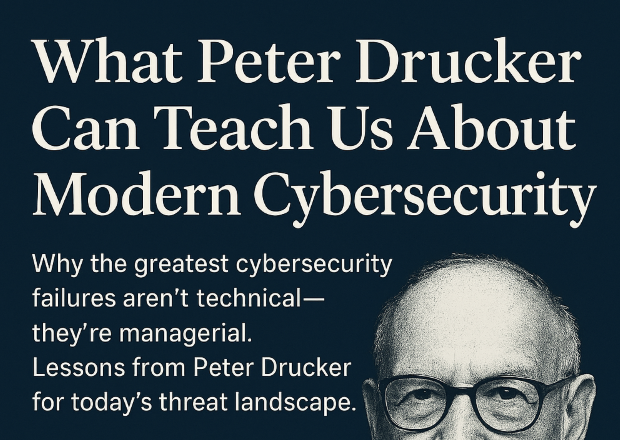
The Real Breaches Start Before the Malware
Most cybersecurity incidents originate from misalignment long before an attacker ever arrives.
Examples include:
- A missed patch because two teams thought the other owned it.
- A risk raised by security that never reaches decision-makers.
- A new integration deployed without security’s awareness.
This directly mirrors Drucker’s warning about friction, confusion, and underperformance.
Supporting reading:
Drucker Principle #1: Clarity of Mission Reduces Friction
Drucker emphasized that organizations drift without clear objectives.
In cybersecurity, a lack of clarity creates chaos:
- Engineering optimizes for speed.
- Security optimizes for risk reduction.
- Leadership optimizes for business outcomes.
Actionable takeaway:
Define and communicate the organization’s top three security priorities.
Relevant source:
Drucker Principle #2: Communication Is Management’s Primary Tool
Drucker argued that most failures—regardless of domain—are communication failures.
Cybersecurity confirms this daily:
- Incident response teams operating on assumptions
- Delayed escalation during incidents
- Security and business leaders speaking different “languages”
Actionable takeaway:
Create structured communication rhythms:
security reviews, cross-team syncs, escalation paths.
Supporting framework:
💡 Want to go deeper?
If you’re aiming to lead a security team, break into cybersecurity, or operate with greater speed and confidence — this is the toolkit you’ve been missing:
🔗 Cybersecurity Leadership OS: Battle-Tested Mental Models for Clarity, Speed & Command
Drucker Principle #3: What Gets Measured Gets Managed — With a Modern Twist
Drucker taught that metrics shape behavior.
In cybersecurity, outdated metrics (e.g., “number of vulnerabilities”) create misleading pictures.
Better, modern metrics include:
- Mean Time to Respond (MTTR)
- Mean Time to Patch for critical issues
- Critical control coverage and reliability
Actionable takeaway:
Measure alignment and readiness, not vanity numbers.
Supporting source:
Drucker Principle #4: Culture Eats Strategy for Breakfast — Especially in Security
Drucker’s famous line—“culture eats strategy for breakfast”—is especially true in cybersecurity.
Examples:
- Undisclosed incidents because employees fear reporting mistakes
- Teams assuming “security is someone else’s job”
- Leaders unintentionally signaling that speed matters more than safety
Actionable takeaway:
Build a culture where security is shared, not delegated.
Reading recommendation:
Sponsored By
💡 Power your growth with the tools I personally use:
- 🚀 Hypefury — The ultimate tool for growing your audience and automating Twitter threads that actually go viral.
- 🎨 Carrd — Build beautiful, responsive landing pages in minutes. Perfect for portfolios, waitlists, and personal branding.
Leadership as the Ultimate Security Control
Tools matter.
Frameworks matter.
Technology matters.
But leadership determines:
- What gets prioritized
- What gets funded
- Who is accountable
- How teams align
- How the organization responds under pressure
Drucker’s insight is timeless:
Everything that doesn’t happen naturally must be created by leadership.
Conclusion: Drucker’s Legacy for the Threat Landscape
Threats evolve fast.
Organizations evolve slowly.
Drucker’s management principles help close that gap.
Because cybersecurity isn’t just technical—it’s organizational.
The strongest defense isn’t a product—it’s an aligned, well-led organization.
💡 If you found this helpful, learn the thinking that separates leaders from followers
🚀 Supercharge Your Cybersecurity Career with 🔗 CyberSHIELD PRO Membership – Unlock Exclusive Benefits Today!
Ultimately, whether you’re spearheading enterprise risk management or mapping out your career trajectory, use this three-step model as a mental guide to build, defend, and evolve in today’s threat environment.
Stay informed, stay empowered,
CyberSHIELD | CybersecurityOS