Posts
OS Weekly: A Chrome Zero-Day, Microsoft's Biggest-Ever Patch Tuesday & Lessons From Museum Heists
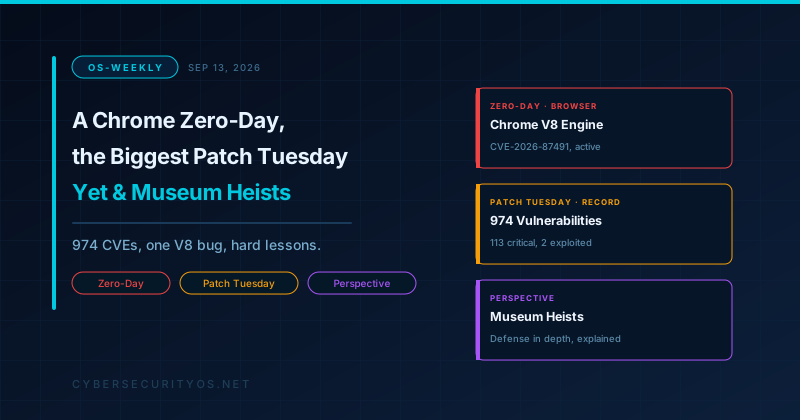
This week’s news skewed toward patching math over dramatic new attack techniques: an actively-exploited Chrome zero-day, and Microsoft’s largest security update to date. Layered underneath is a good reminder that some of the best security intuition doesn’t come from a terminal at all. Here’s what’s worth your attention.
Critical Threats & Patches
Chrome’s V8 engine has an actively-exploited zero-day

Google shipped updates fixing 230 security vulnerabilities this week, including CVE-2026-87491 — an out-of-bounds write bug in Chrome’s V8 JavaScript and WebAssembly engine. The CVSS score hasn’t been published, but the flaw is already being exploited in the wild, which is the detail that matters most here.
Browser-engine bugs remain one of the highest-leverage attack surfaces in existence: a single malicious page can translate into code execution inside the sandbox. Verify that auto-update is actually running across your organization’s Chrome and Chromium-based fleet — Edge, Brave, Opera included — rather than assuming “it updates itself” means it has.
Microsoft just shipped its largest Patch Tuesday ever

Microsoft’s September 2026 security update is its biggest yet, addressing roughly 974 vulnerabilities — 113 of them rated critical. Two are already being actively exploited, and Microsoft flagged an additional 58 as highly likely to be targeted in the near future. Microsoft credits AI-assisted analysis with accelerating vulnerability discovery, but as several researchers noted this week, the bottleneck has shifted downstream to the defenders who now have to prioritize, test, and deploy patches at a volume that’s becoming difficult to manage manually.
The practical takeaway: don’t try to patch everything at once. Triage the actively-exploited and critical-rated vulnerabilities first, and treat sequencing the rest as its own skill worth developing — this volume of monthly patching isn’t going away. That triage step is where most teams actually lose the week, which is why we run our own CVE lookup and prioritization workflow through Make, a visual automation tool that handles the dedupe-and-alert grunt work without babysitting a cron job. Affiliate link — signing up may support CyberShield at no extra cost to you.
Perspective
What museum heists can teach you about breach prevention

A thoughtful piece this week drew out the structural similarities between museum heists and cybersecurity breaches: skilled, patient adversaries, exploitable human error, high-value targets, and the exploitation of physical or digital blind spots. The piece doesn’t go deep on applying these lessons to a hardened security strategy, but the framing itself is genuinely useful — especially for explaining “defense in depth” to non-technical stakeholders who understand physical security intuitively but glaze over at network diagrams.
If you’re the one who ends up building that explainer deck or the incident writeup afterward, having a clean way to turn the analogy into something visual makes it land faster. We build our own threat-brief slides and breach timelines off a Canva template kit made for security folks — dark-mode palettes and diagram blocks included, ready to remix instead of built from scratch each time. Affiliate link — signing up may support CyberShield at no extra cost to you.
That’s the week. Patch what’s actively exploited first, don’t assume auto-update is doing its job, and remember that the best security explanations often borrow from the physical world. Follow CyberShield for the next one.