Posts
OS Weekly: Node2Shell, Stolen AI Keys & Poisoned Dev Tools
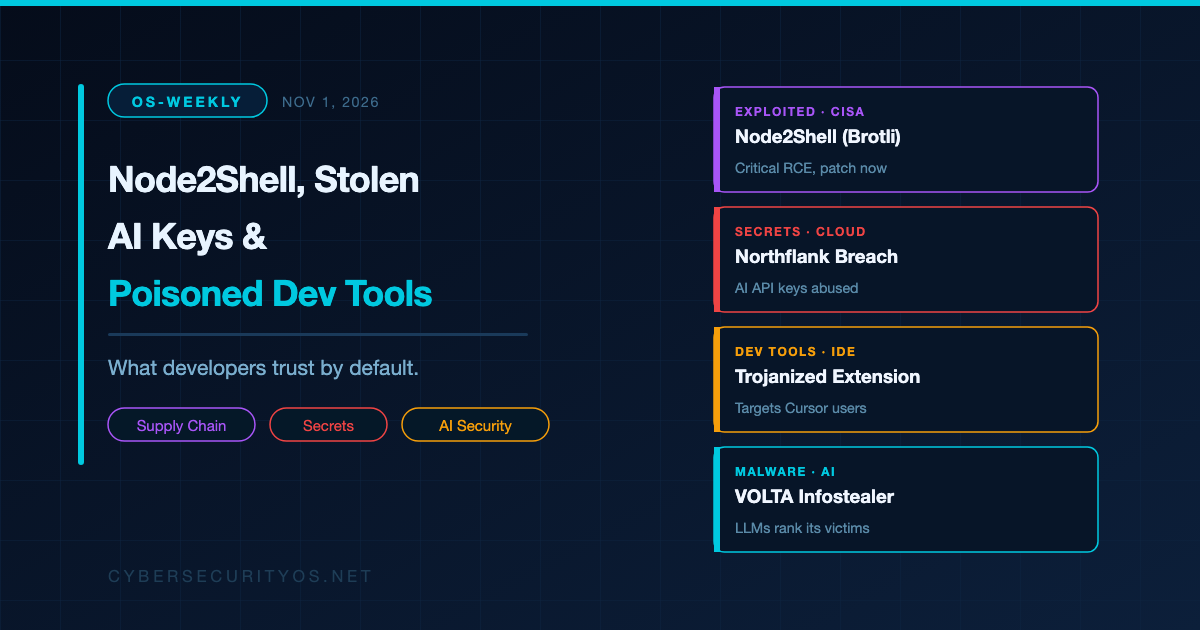
This week’s theme is the stuff developers trust by default: a compression library, a hosting platform holding your secrets, and the extensions inside your IDE. Attackers went after all three, while new research showed both criminals and defenders putting AI models to work. Here’s what working and aspiring security pros need to know.
Critical Threats
CISA: Attackers Are Exploiting the Critical Node2Shell Flaw

On Tuesday, CISA confirmed that hackers are exploiting a critical vulnerability in Brotli compression, known as Node2Shell, Broccoli2Shell, and HTTP2Shell. The flaw allows remote code execution, and organizations that rely on Brotli are being told to apply the available patches or deploy workarounds.
Why it matters: compression code sits deep inside web stacks, often pulled in as a dependency nobody thinks about until a bulletin like this one lands. Once CISA confirms exploitation, you’re on a clock. Know which of your services depend on Brotli, directly or through a framework, and patch those first. If you’re early in your career, practice tracing a vulnerable library through a dependency tree. It’s one of the most useful skills you can show in an interview.
Read more at BleepingComputer →
Tools I use: Alerts like this one are where I stopped relying on reading feeds by hand. I use Make to pipe vulnerability feeds into enrichment and a phone alert, so the critical ones reach me without another cron job to maintain. That’s my own setup and recommendation, not part of this story. (Affiliate link: it supports CybersecurityOS at no cost to you.)
Northflank Breach Leads to Abuse of Customers’ AI API Keys

Cloud application hosting platform Northflank suffered a security breach that resulted in unauthorized use of customers’ AI API keys. The company is advising customers to rotate all credentials and secrets stored on its platform.
Why it matters: AI API keys are now high-value secrets. They cost real money when abused, and they often sit next to everything else in a platform’s secret store. If you use Northflank, rotate now, not just the AI keys. For everyone else, ask a simple question: if your hosting provider were breached tomorrow, how fast could you rotate every secret it holds? If the honest answer is “days,” that’s your project for this quarter.
Read more at BleepingComputer →
A Trojanized Claude Code Extension Targets Cursor Developers

Dark Reading reports that Cursor, the AI-powered IDE, dealt with two significant security incidents on the same day, including a trojanized Claude Code extension aimed at Cursor users.
Why it matters: the IDE is a privileged environment. It holds source code, tokens, and cloud credentials, and extensions run with a lot of that access. Treat extensions like any other third-party software: install from verified publishers, keep an allowlist for your team, and review what’s installed on developer machines. AppSec and endpoint folks, this is squarely your territory now.
VOLTA Infostealer Uses LLMs to Decide Which Victims Are Worth It
Cisco Talos details VOLTA, an infostealer that steals credentials, online sessions, and cryptocurrency wallets. What stands out is that it uses large language models to analyze and profile victims, then ranks the most valuable assets it has collected. It also deletes itself to remove traces of its presence.
Why it matters: attackers are using AI for triage, the same way defenders do. Stolen session data is especially dangerous because it can let attackers skip the login step entirely. Strong authentication, short session lifetimes, and fast session revocation all limit how much a stolen session is worth. For SOC analysts, a self-deleting payload means your telemetry has to catch it while it runs, because there may be nothing left on disk afterward.
Vulnerabilities & Patches
CVSS 10.0 Flaw Let Attackers Impersonate Trusted LXD and MicroCloud Clients

A vulnerability rated CVSS 10.0 in Canonical’s LXD and MicroCloud allowed attackers to log in as a trusted client without the client’s private key. An attacker needed network access to the HTTPS API and the trusted client’s public certificate. From there, they could act as that client and gain access to the cluster and its virtual machines.
Why it matters: public certificates are, by design, not secret, so a flaw that turns one into a login is about as bad as it gets. If you run LXD or MicroCloud, update and restrict who can reach the management API. Management interfaces belong on a locked-down network, not the open internet, even when the authentication looks strong.
Read more at The Hacker News →
Anthropic’s Unreleased AI Model Chained Flaws Into Working Exploits
An unreleased Anthropic AI model found security flaws in Chrome, Safari, Android, Windows, and Linux, and chained them into proof-of-concept exploits in a lab setting. The exploits weren’t part of any real-world attack, and all the vulnerabilities were reported to and patched by the vendors.
Why it matters: AI models finding and chaining bugs in major platforms is going to show up more often in patch notes. Expect more fixes, arriving faster, which raises the cost of slow patch cycles. The responsible disclosure here is the model to follow. For aspiring pros, understanding how individual bugs combine into an exploit chain is becoming more valuable, not less.
Read more at The Hacker News →
Tools I use: If you’re building a security career, a simple personal site where you post write-ups like these does a lot of work for you. I use Carrd for quick one-page sites. It’s my own recommendation, unrelated to this story’s source. (Affiliate link: it supports CybersecurityOS at no cost to you.)
Also This Week
- Interpol’s third Operation Serengeti sweep: 1,462 arrests and $105 million recovered across 20 African countries and the U.S.
- Talos’ Ryan Fetterman on what “blue collar” means for detection engineers, and how to build a career without burning out
- Ask HN: a sysadmin asks how to responsibly build an agent that tracks CVEs for their stack
- Mantic: “Black October and the Future of Cybersecurity”
That’s the week. Patch Node2Shell, plan to rotate every secret your providers hold, and audit what’s running inside your IDE. We’ll see you next Sunday. Follow along for daily updates in between.