Posts
OS Weekly: A Poisoned Extension Marketplace, AI-Profiling Malware & Qilin Unmasked
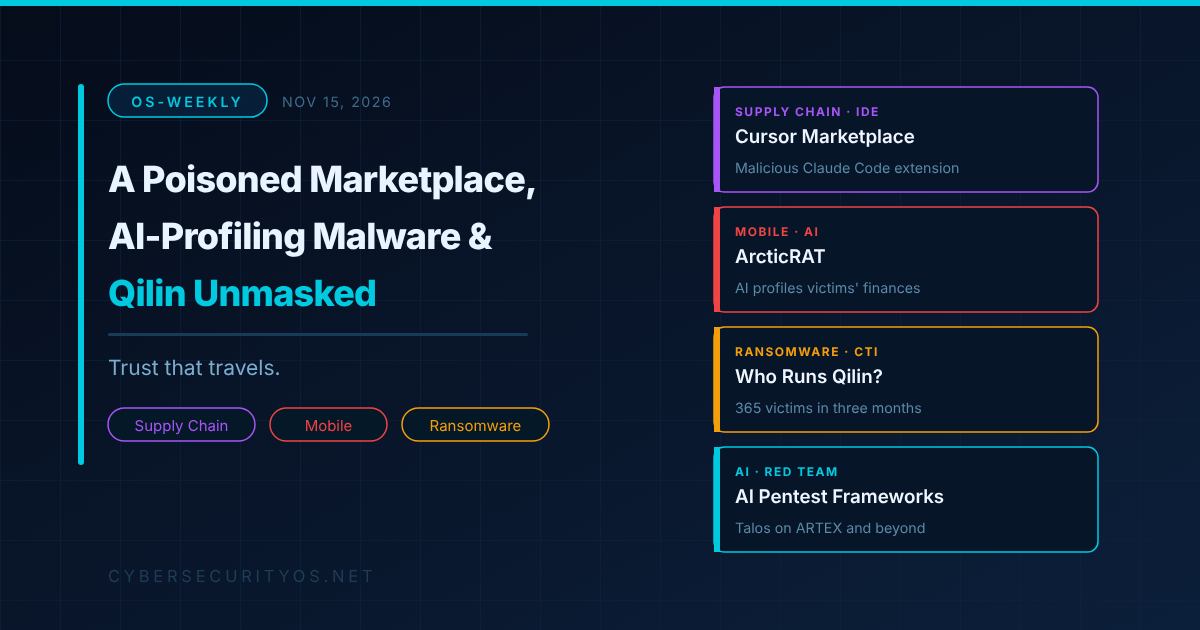
This week’s theme is trust that travels: a partner’s stolen credentials that ended up pushing malware through a developer marketplace, malware that now does its own homework on victims, and the human side of security, from a ransomware boss’s opsec slip to the quiet conversations corporate security teams rarely see. Here’s what working and aspiring security pros need to know.
Critical Threats
Cursor Confirms Breach Led to a Malicious Claude Code Extension

Cursor, the AI-powered code editor, confirmed a security breach. Hackers stole credentials from Fireworks AI, an AI infrastructure provider, and the breach led to a malicious Claude Code extension being distributed through Cursor’s marketplace.
Why it matters: the attackers didn’t need to break Cursor’s own front door. A credential stolen from a partner was enough to reach a channel developers already trust. If your team installs IDE extensions freely, that marketplace is part of your attack surface. Keep an allowlist of approved extensions, scope and rotate the API keys you hand to third-party services, and make sure you could tell within a day which machines installed a given extension.
Read more at BleepingComputer →
ArcticRAT Gang Now Uses AI to Profile Victims’ Finances

The ArcticRAT cybercrime gang’s Android malware started out focused on cryptocurrency theft. It has evolved to take complete control of infected devices, and the attackers now use AI to analyze stolen data and profile their victims’ finances.
Why it matters: full device control plus automated analysis means attackers can work out who is worth targeting faster than a human operator could. For defenders, the phone is now a primary target, not a side channel. Only allow apps from official stores on managed devices, enforce mobile threat defense where you can, and teach users that a “helpful” app asking for accessibility or device-admin rights is a red flag.
Who Runs Qilin, the Busiest Ransomware Program Right Now?

Qilin is now the most active ransomware affiliate program, with 365 victims in the last three months. A KrebsOnSecurity investigation found that operational security mistakes by its administrator point to a 36-year-old man from St. Petersburg, Russia.
Why it matters: two lessons. First, an affiliate model means many different crews use the same ransomware, so your defenses have to cover a wide range of entry points rather than one group’s playbook. Second, even prolific operators leave traces, which is why threat intelligence and patient investigation pay off. If you’re building toward a CTI role, read the full piece as a case study in pivoting from small clues to attribution.
Read more at KrebsOnSecurity →
Tools & Strategy
AI-Enabled Pentest Frameworks: ARTEX and Beyond

Cisco Talos looks at ARTEX and other AI-driven penetration testing and red team frameworks. These tools automate reconnaissance, vulnerability assessment, and follow-on actions. Talos notes the flip side: in the wrong hands, they lower the skill needed to attack and shorten intrusion timelines.
Why it matters: if attackers can move from recon to exploitation faster, the window between a weakness appearing and someone using it gets shorter. That makes the basics more important, not less: know your external attack surface, patch what’s exposed first, and test your detections against automated activity. For aspiring pros, learning how these frameworks work is quickly becoming part of both red and blue team skill sets.
Tools I use: Speaking of automation, when I want my own lab and content workflows to run themselves (pulling feeds, routing alerts, logging results), I wire them up in Make. That’s my own recommendation, not part of this story or its source. (Affiliate link: it supports CybersecurityOS at no cost to you.)
Industry News
Italy Fines Meta €805 Million Over Android Gallery Access
Italy’s data protection authority, the Garante, fined Meta €805 million over a Facebook for Android feature that suggests photos and videos from users’ phone galleries for posting. The feature was on by default, and the app accessed users’ photos, videos, and metadata without explicit consent. Meta has 60 days to respond.
Why it matters: privacy is a security and engineering problem, not just a legal one. “On by default” features that touch personal data are exactly what regulators look for. If you work in AppSec or GRC, add a consent and data-access check to feature reviews, and make sure your product teams can show when and how users agreed.
Read more at The Hacker News →
Where Was Nvidia’s Security Team?
Nvidia’s longtime chief security officer stepped down in August, and CEO Jensen Huang left about two and a half months later amid questions about his relationships, starting with an executive at Megaspeed, a Singapore data center company that U.S. investigators suspect of funneling Nvidia chips to China. Megaspeed denies wrongdoing, and TechCrunch notes no public link between the security leadership change and the Megaspeed matter. A retired senior intelligence officer told TechCrunch that this kind of information leak often happens through everyday conversation, which many corporate security teams aren’t equipped to detect.
Why it matters: most security programs are built to catch technical intrusions, not relationships. Insider risk and foreign influence programs are often underfunded because they don’t produce revenue. If you’re in a leadership track, this is a useful example for making the case that insider risk deserves its own budget line and executive sponsorship.
Tools I use: If you’re thinking about starting your own security newsletter or portfolio blog, OS Weekly itself runs on Kit, which I use to send this newsletter and manage the CybersecurityOS list. That’s my own recommendation, unrelated to any story here. (Affiliate link: it supports CybersecurityOS at no cost to you.)
That’s the week. Check which IDE extensions your team can install and who approved them, review what your managed phones are allowed to install, and pick one detection to test against fast, automated attack activity. We’ll see you next Sunday. Follow along for daily updates in between.