Posts
OS Weekly: A vCenter Zero-Day, Stolen AI Prompts & a Fake Ransomware Fixer
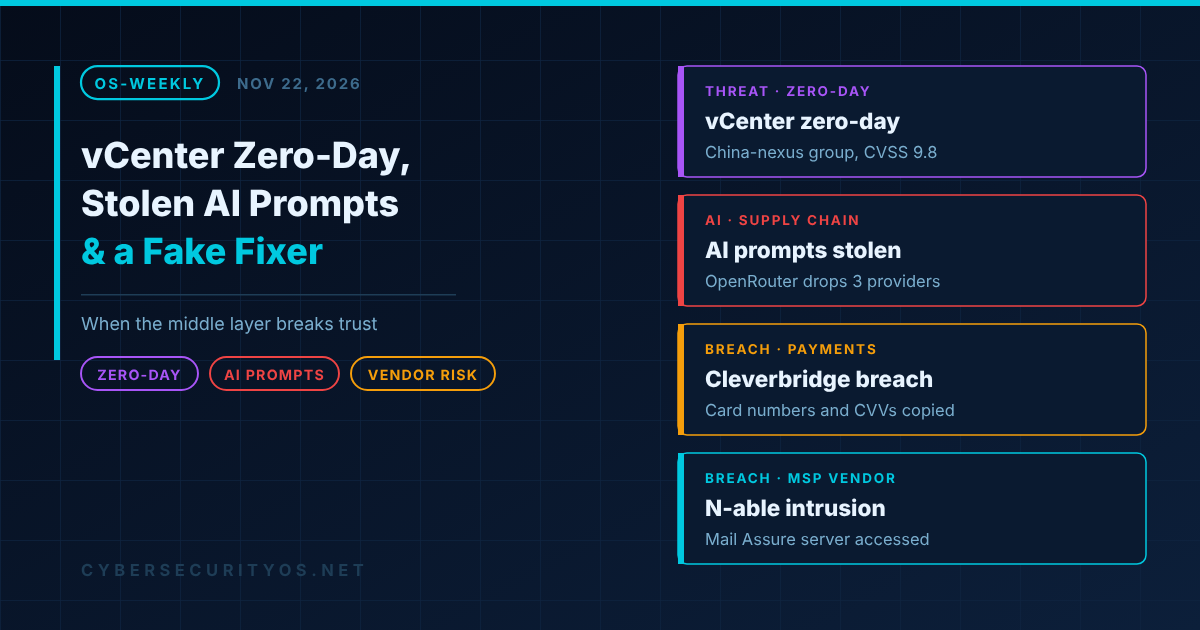
This week is about the layer in the middle: the management plane that runs your VMs, the router that passes your AI prompts along, the platform that takes your card payment, and the firm you hire when ransomware hits. Every one of them asks for trust, and this week several broke it. Here’s what working and aspiring security pros need to know.
Critical Threats
China’s Armory Castle Exploited a vCenter Zero-Day for Months

Mandiant has detailed how Armory Castle, a China-nexus group formerly tracked as UNC5221, chained its way from a BeyondTrust Remote Support appliance into VMware vCenter using a critical (CVSS 9.8) authentication bypass that has only now come to light, months after it was first exploited. In one September attack the group hit a victim that had already patched vCenter. Its custom tooling copied vCenter’s internal directory database, created new admin accounts, and forged authentication tokens from the stolen login-signing key, which bypassed MFA, before moving on to ESXi hosts. Broadcom has issued an advisory recommending customers update.
Why it matters: patching the last batch of vCenter flaws did not end this campaign, because the attackers already had another one. Treat your virtualization management plane as tier-zero: isolate it from user networks, put tight controls on admin accounts, and forward vCenter and ESXi logs to a separate SIEM, since attackers can wipe local logs. If you’re early in your career, learning how vCenter, ESXi, and identity fit together is a skill that shows up in real incident work.
OpenRouter Drops Three AI Providers After Months of Prompt Theft

Dragos seeded about two million prompts with unique links and fake credentials between July and November, then watched for anyone using them. Attackers had been stealing data from inside three AI inference providers, and none of the three noticed until the researchers told them. Some of the stolen requests were flagged Zero Data Retention, the setting that is supposed to mean a prompt is never stored. Planted AWS keys were used for tens of thousands of API calls. OpenRouter, which routes customer requests to a pool of providers, removed three providers, pulled 125 endpoints from ZDR eligibility until they are validated again, and notified affected customers. It says the findings showed no breach of OpenRouter itself.
Why it matters: a “no retention” label is a promise, not a control you can see. Anything you paste into a model through a third party, including secrets, customer data, and internal code, can end up somewhere you didn’t choose. Keep credentials out of prompts, pick upstream providers deliberately instead of accepting a default pool, and consider planting your own canary tokens so you’ll know if prompts leak.
Read more at The Hacker News →
Cleverbridge Says Hackers Copied Stored Payment Card Data

Cleverbridge, which runs e-commerce, payments, and subscriptions for software and SaaS companies, detected unauthorized activity on November 4 and later determined that a third party copied payment card data stored on its platform. A breach notice seen by BleepingComputer says the stolen data included card numbers, expiration dates, and CVV/CVC codes. Cleverbridge says it was not ransomware, hasn’t said how many people were affected, and is offering free credit monitoring through TransUnion’s Cyberscout.
Why it matters: if you bought software from a vendor that uses Cleverbridge, your card may be exposed even though you never heard of the company. For defenders, it’s a reminder that your payment processor is part of your attack surface, and that PCI DSS bars storing CVV codes after authorization for exactly this reason. If you’re affected, check your statements and call your card issuer.
Read more at BleepingComputer →
Tools I use: I post daily threat updates on X between issues, and I queue them up with Hypefury so they go out on schedule even on busy incident days. That’s my own recommendation, not part of this story or its source. (Affiliate link: it supports CybersecurityOS at no cost to you.)
Industry News
N-able Confirms a Breach Behind Its Mail Assure Outage

N-able first blamed a worldwide outage of its Mail Assure and SpamExperts Hosted Cloud services on platform configuration. About a day later it confirmed “unauthorized access to one of the servers” in that environment, disabled UI and API access, and took down the management portal along with quarantine, logging, and mailbox sync services. N-able says email flow and spam filtering were not affected and that it has no evidence customer data or tenant mailboxes were compromised. The investigation is ongoing, and N-able says it’s unrelated to a separate N-central incident.
Why it matters: the first explanation for an outage isn’t always the final one. When a vendor that sits in your mail flow reports an incident, track their advisories, be ready to work without the console for a while, and know which integrations and credentials you’d rotate if the scope grows.
Read more at BleepingComputer →
Ransomware “Recovery” Firm’s CTO Indicted for Wire Fraud
The CTO and co-founder of ransomwarehelp.com, a six-year-old Florida company, has been indicted for wire fraud. The firm told victims “Do not pay the ransom!” and claimed its cryptography experts could recover data with proprietary tools. The indictment alleges it routinely paid ransomware groups for decryption keys and billed victims far more for work it never did. In an FBI sting, agents posed as both a victim and a fake ransomware gang. The case is an allegation; no plea has been reported.
Why it matters: in a ransomware crisis, the vendor you pick is a security decision too. Ask recovery firms for their method in writing and for disclosure of any contact with or payment to attackers, check references, and bring in legal counsel, your insurer, and law enforcement. Tested offline backups are what keep you from being desperate enough to fall for a claim like “100% data recovery.”
Read more at KrebsOnSecurity →
Tools I use: If you’re building a security career, a simple one-page site that links your write-ups, home lab, and résumé does a lot of work. I build mine on Carrd. That’s my own recommendation, not part of this story or its source. (Affiliate link: it supports CybersecurityOS at no cost to you.)
That’s the week. Check whether your vCenter and ESXi logs leave the box they’re about, list every third-party AI service your team sends prompts to and what each one promises about retention, and make sure your ransomware plan names the outside firms you’d call before you need them. We’ll see you next Sunday. Follow along for daily updates in between.