Posts
From Security Engineer to Security Leader: What Changes?
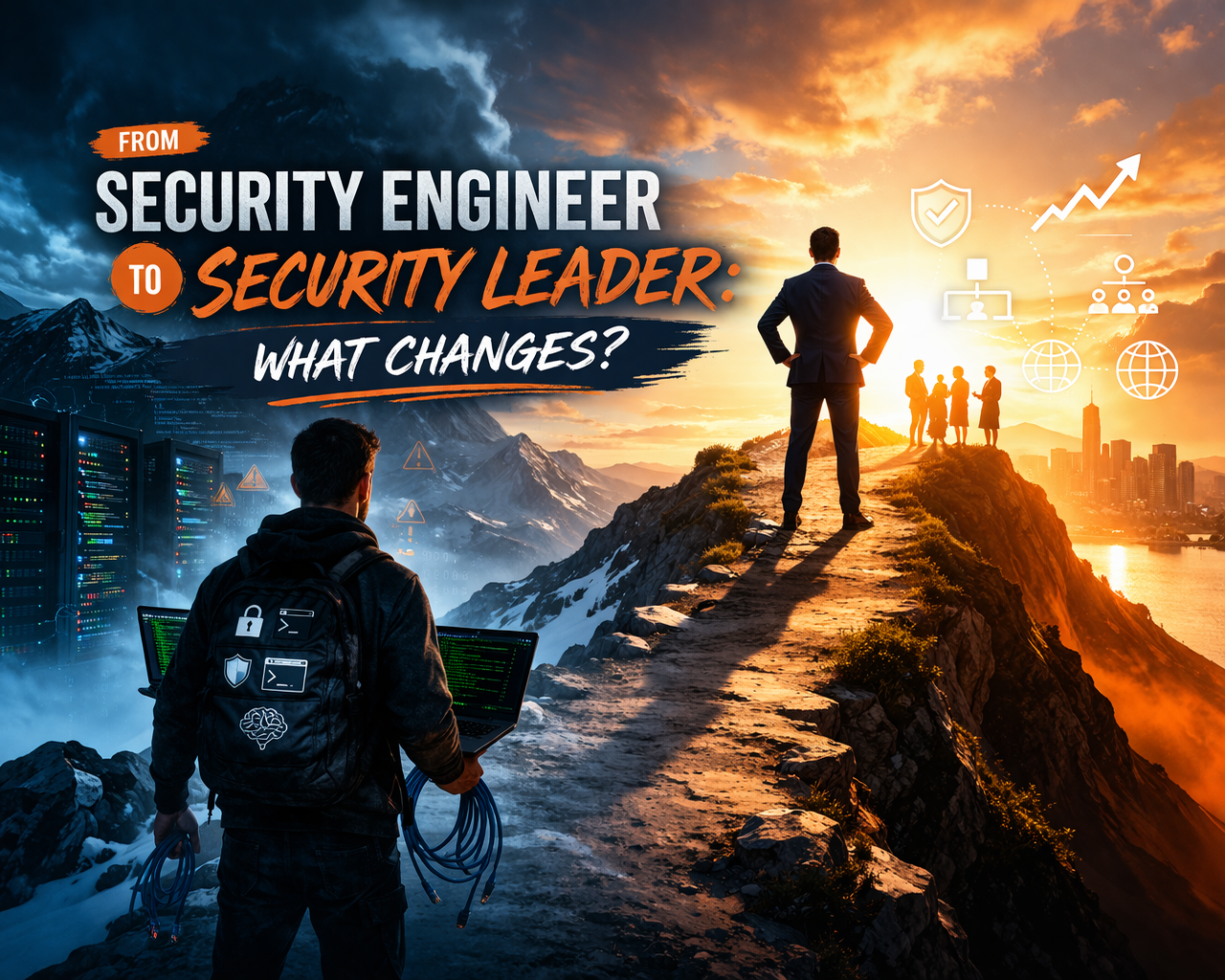
Most people think the jump from Security Engineer to Security Leader is just a promotion.
It’s not.
It’s a complete shift in how you think, how you make decisions, and how you create impact.
If you approach leadership the same way you approached engineering, you’ll feel stuck, overwhelmed, and constantly pulled back into the weeds.
Here’s what actually changes.
1. You Stop Solving Problems — And Start Defining Them
As an engineer, your value comes from solving clearly defined problems:
- Investigate the alert
- Patch the vulnerability
- Deploy the control
As a leader, the hardest part is figuring out what the real problem is in the first place.
Because most organizations don’t have a tooling problem.
They have:
- A prioritization problem
- A communication problem
- A risk understanding problem
Your role shifts from:
“How do we fix this?”
to
“What actually matters, and why?”
2. Depth → Breadth
Great engineers go deep.
They know:
- Exactly how an attack works
- Exactly how a control fails
- Exactly how to fix it
Great leaders go broad.
They understand:
- How security connects to business objectives
- How risk flows across systems, teams, and vendors
- How decisions in one area create exposure in another
You don’t need to know everything.
But you need to understand how everything fits together.
3. Output → Outcomes
As an engineer, success looks like:
- Tickets closed
- Alerts resolved
- Systems hardened
As a leader, none of that matters on its own.
What matters is:
- Is risk actually reduced?
- Are we making better decisions?
- Are we resilient when things go wrong?
You’re no longer measured by what you do.
You’re measured by what changes because of what you do.
4. Tools → Tradeoffs
Engineers optimize for the best solution.
Leaders optimize for the best tradeoff.
Because in the real world:
- You don’t have unlimited budget
- You don’t have unlimited time
- You don’t have perfect information
Every decision becomes a balancing act between:
- Security vs. speed
- Risk vs. revenue
- Control vs. usability
Leadership is the ability to make clear, defensible tradeoffs under uncertainty.
5. Execution → Influence
As an engineer, you execute.
As a leader, you influence.
You don’t:
- Own every system
- Control every team
- Make every decision
Instead, you:
- Align stakeholders
- Shape priorities
- Drive action without authority
Your effectiveness depends less on what you know…
…and more on how well you can move people.
6. Certainty → Ambiguity
Engineering rewards certainty:
- Logs confirm the issue
- Data proves the vulnerability
- Fixes can be validated
Leadership lives in ambiguity:
- Incomplete data
- Conflicting priorities
- Unclear risk
You will rarely have all the information you want.
But you’re still expected to make the call.
7. Individual Contribution → System Design
At the highest level, leadership is about designing systems:
- Decision-making systems
- Communication systems
- Security operating models
- Incident response structures
You’re no longer the one responding to incidents.
You’re the one designing how the organization responds to incidents.
8. Technical Skill → Judgment
Technical skill gets you into the room.
Judgment determines whether people trust you once you’re there.
This includes:
- Knowing when to escalate
- Knowing when to accept risk
- Knowing when to push back
- Knowing when to move fast
There’s no playbook for this.
It’s built through experience, pattern recognition, and reflection.
The Identity Shift Most People Miss
The hardest part isn’t learning new skills.
It’s letting go of your old identity.
Many new leaders struggle because they still think:
“I need to be the smartest technical person in the room.”
You don’t.
Your job is to make sure the room produces the right outcomes.
💡 Want to go deeper? >
If you’re aiming to lead a security team, break into cybersecurity, or operate with greater speed and confidence — this is the toolkit you’ve been missing:
🔗 Cybersecurity Leadership OS: Battle-Tested Mental Models for Clarity, Speed & Command
Final Thought
The move from Security Engineer to Security Leader is not about doing more.
It’s about doing different.
- Less control, more influence
- Less certainty, more judgment
- Less execution, more direction
If you can make that shift intentionally…
You don’t just grow your career.
You expand your impact.
Want to Accelerate This Transition?
If you’re trying to break into leadership or operate at a higher level, you need more than experience.
You need frameworks.
That’s exactly what I’ve built inside Cybersecurity Leadership OS:
- 30+ mental models for security leaders
- Decision-making frameworks used at the executive level
- Real-world scenarios (incidents, board conversations, tradeoffs)
- Communication templates to influence leadership
Because leadership isn’t something you “figure out” over time.
It’s something you can learn deliberately.
Stay informed, stay empowered,
CyberSHIELD | CybersecurityOS