Posts
Security KPIs That Actually Matter: What to Report to the Board
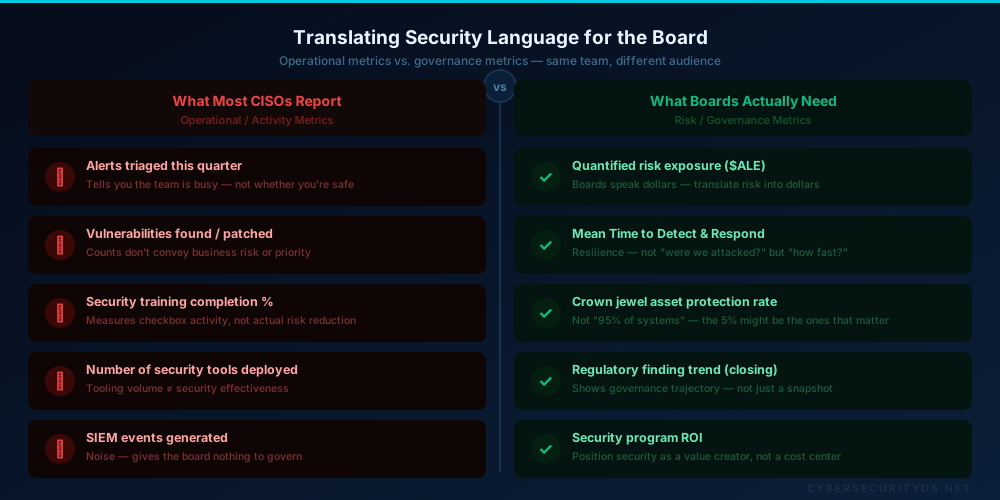
Most CISOs walk into board meetings and report something like this:
“We patched 1,247 vulnerabilities this quarter. Our SIEM generated 43,000 alerts. Security training completion is at 98%.”
The board nods. The CFO checks their phone. The meeting moves on.
And no one in that room — including the CISO — is any clearer on whether the company faces material risk.
This is the core problem with security board reporting: the metrics security teams naturally track are operational metrics. Boards don’t need operational visibility. They need risk governance visibility. Those are completely different things — and confusing the two is one of the most common and costly mistakes in security leadership.
This guide covers the security KPIs that actually matter at the board level, why they matter, how to frame them in language boards understand, and real-world examples of what happens when organizations get this right — and catastrophically wrong.
Why Most Security Metrics Fail in the Boardroom
Security teams are trained to measure activity. Alerts triaged. Patches applied. Vulnerabilities found. These are process metrics — they tell you whether the security team is busy, not whether the business is exposed.
Boards have three questions. Every board, every quarter, regardless of industry:
- Are we exposed to a risk that could materially harm the business?
- If something goes wrong, can we recover — and how fast?
- Are we doing what we said we’d do?
That’s it. Every KPI you bring to the board should answer one of those three questions. If it doesn’t, cut it.
The disconnect runs deeper than presentation style. Most security metrics are lagging indicators — they measure what already happened. Boards need a balance of leading indicators (what’s likely to happen) and lagging indicators (what happened and how we responded). Reporting only on past activity gives the board a rearview mirror when they need a windshield.
The Regulatory Context You Can’t Ignore
Before the KPI framework: security board reporting is no longer just best practice.
In December 2023, the SEC adopted new cybersecurity disclosure rules requiring public companies to disclose material cybersecurity incidents within four business days and to provide annual disclosures covering cybersecurity risk management, strategy, and governance. The rule explicitly requires board oversight of cybersecurity risk to be described in annual reports.
ISO 27001:2022 includes a dedicated clause (Clause 9.3) requiring management reviews that address cybersecurity performance — including objective, measurable results against security objectives.
NIST CSF 2.0 (released February 2024) elevated the Govern function to a first-class function for the first time, placing risk governance — including board and executive reporting — at the center of the framework rather than treating it as an afterthought.
The implication: security metrics are now a governance obligation, not just an internal management tool. CISOs who can’t translate their security posture into boardroom language are creating regulatory exposure on top of security exposure.
The Four-Tier KPI Framework
Effective board security reporting is organized into four tiers, each answering a distinct governance question. This maps to both NIST CSF 2.0 functions and ISO 27001:2022 clauses.
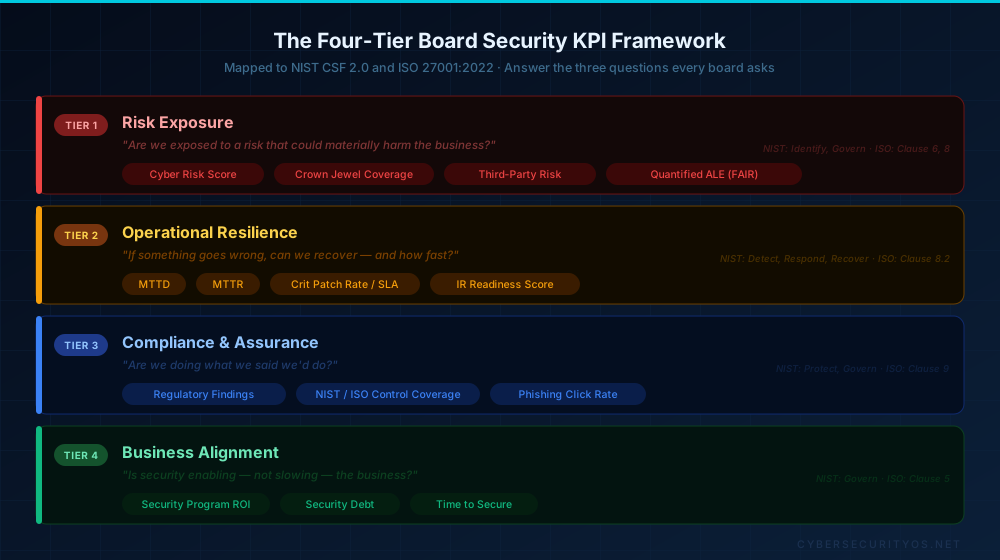
| Tier | Board Question | NIST CSF Mapping | ISO 27001 Mapping |
|---|---|---|---|
| 1. Risk Exposure | Are we exposed? | Identify, Govern | Clause 6 (Planning), Clause 8 (Operation) |
| 2. Operational Resilience | Can we recover? | Detect, Respond, Recover | Clause 8.2 (Information Security Risk Assessment) |
| 3. Compliance & Assurance | Are we doing what we said? | Protect, Govern | Clause 9 (Performance Evaluation) |
| 4. Business Alignment | Is security enabling growth? | Govern | Clause 5 (Leadership) |
Tier 1: Risk Exposure KPIs
These answer the board’s first question: Are we exposed to a risk that could materially harm the business?
Cyber Risk Score / External Attack Surface Rating
What it is: A scored assessment of your organization’s externally visible security posture, typically from a platform like SecurityScorecard, BitSight, or Bitsight. Scores range 0–100 (or letter grade).
Why boards care: It’s the credit score equivalent for cyber risk. Insurance underwriters, enterprise clients, and M&A due diligence teams use it. A degrading score is a leading indicator of increased breach likelihood and a commercial risk.
How to present it:
“Our SecurityScorecard rating is 82/100, up from 74 last quarter. Industry peer average is 78. The improvement was driven by closing 14 open DNS misconfiguration findings.”
Benchmark: Companies with scores below 60 are five times more likely to experience a breach than those scoring 90+ (SecurityScorecard research).
Crown Jewel Asset Coverage
What it is: The percentage of your organization’s highest-value assets — systems and data stores containing customer PII, financial records, IP, or operational technology — that have full security controls in place (encryption, access controls, monitoring, and tested recovery).
Why boards care: Not all assets are equal. Boards need to know whether the things that matter most are protected. “We secured 95% of systems” means nothing if the 5% unprotected includes the customer payment database.
How to present it:
“100% of Tier 1 crown jewel systems now have full control coverage. One legacy system in Tier 2 remains partially exposed — remediation is scheduled for Q3.”
Third-Party Risk Exposure
What it is: The number of critical vendors and partners with unresolved material security findings, and the trend over time.
Why boards care: Supply chain attacks have become a primary attack vector. The SolarWinds attack (2020) compromised 18,000+ organizations through a single vendor update. The Okta breach (2023) cascaded to MGM, Caesars, and others. Your security is only as strong as your weakest vendor.
How to present it:
“We have 12 Tier 1 vendors. 3 have open material findings. 2 have accepted remediation plans in place; 1 is under review for contract termination.”
What to track: Number of critical vendors with unresolved findings, response rate to security questionnaires, and time to remediation.
Quantified Cyber Risk (Annualized Loss Expectancy)
What it is: A financial estimate of the organization’s top cyber risk scenarios, using frameworks like FAIR (Factor Analysis of Information Risk) to produce a range: “A ransomware incident against our manufacturing OT environment has an annualized loss expectancy of $8M–$22M.”
Why boards care: This is the only metric that speaks the language every board already uses: dollars. It lets the board compare cyber risk to other enterprise risks on the same scale.
How to present it: Present the top 3–5 threat scenarios with quantified ranges. Pair each with the cost of the control that would reduce the risk and the expected reduction in ALE.
“Implementing privileged access management for OT systems would reduce ransomware ALE from $12M to $3M at a cost of $400K.”
This is how you justify security budget in board-level language.
💡 Want the full framework for communicating risk at the executive level?
Built for CISOs and security leaders who need to translate complex risk into business decisions. 30+ mental models, board reporting frameworks, and real-world guides. 🔗 Get the Cybersecurity Leadership OS
Tier 2: Operational Resilience KPIs
These answer the board’s second question: If something goes wrong, can we recover — and how fast?
Mean Time to Detect (MTTD)
What it is: The average time from when an attack begins until your team detects it — measured in hours or days.
Why boards care: Every hour an attacker goes undetected is an hour of lateral movement, data exfiltration, and impact. The IBM Cost of a Data Breach Report 2023 found that breaches with an MTTD under 200 days cost organizations $1.02M less than those detected after 200 days.
Benchmark: The global average MTTD is approximately 194 days (IBM, 2023). Industry leaders operate under 30 days. Best-in-class security operations centers (SOCs) target under 24 hours for high-severity incidents.
How to present it:
“Our average MTTD for high-severity incidents is 11 days — down from 34 days twelve months ago. Industry average is 194 days.”
Mean Time to Respond (MTTR)
What it is: The average time from detection to containment and remediation.
Why boards care: This is the measure of your organization’s resilience — not whether you get hit, but how fast you recover. Post-breach costs scale directly with dwell time.
Real-world example: The Equifax 2017 breach — which cost the company over $700M in settlements — involved a critical Apache Struts vulnerability that had a patch available 79 days before the breach. A disciplined patch SLA with MTTR tracking would have flagged this as overdue. MTTR wasn’t just a technical failure; it was a governance failure.
How to present it:
“MTTR for critical incidents averaged 6 hours in Q2, within our 8-hour SLA target. We have not exceeded our 24-hour SLA for any Tier 1 incident this year.”
Critical Vulnerability Patch Rate Within SLA
What it is: The percentage of critical CVEs (Common Vulnerabilities and Exposures — CVSS score 9.0+) patched within your defined service level agreement (typically 72 hours for critical, 7 days for high).
Why boards care: Unpatched critical vulnerabilities are the single most common initial access vector for ransomware and breach events. This metric is a direct measure of how quickly the organization closes known doors.
Benchmark: Industry-leading organizations maintain 95%+ patch rate within SLA for critical vulnerabilities. Sub-80% rates in critical systems warrant board-level attention.
How to present it:
“97% of critical CVEs were patched within our 72-hour SLA in Q2. Three exceptions were due to legacy OT systems that require planned maintenance windows — all three have accepted risk documentation and mitigating controls in place.”
Incident Response Readiness Score
What it is: The outcome score from your most recent tabletop exercise or incident response test, rated against defined criteria: detection speed, escalation accuracy, communication clarity, recovery execution.
Why boards care: After the MGM Resorts breach (September 2023) — which caused an estimated $100M in losses from a ransomware attack — investigations revealed that incident response processes had not been tested against the specific scenario that was exploited (social engineering of the IT help desk). Testing is the only way to validate readiness.
How to present it:
“Q1 tabletop exercise tested a ransomware scenario targeting our payment processing environment. Score: 78/100. Key gaps identified: backup restoration time exceeded target by 4x; external communication protocol was unclear. Both gaps have associated remediation plans.”
Tier 3: Compliance & Assurance KPIs
These answer the board’s third question: Are we doing what we said we’d do?
Regulatory Finding Trend
What it is: The total number of open regulatory and audit findings over time, segmented by severity, and the closure rate.
Why boards care: Regulators are increasingly aggressive. Under the SEC’s 2023 cybersecurity rules, material findings and governance failures can trigger personal liability for board members. A growing backlog of open findings is a direct governance risk.
How to present it: Show a trend chart — not a snapshot. A CISO who shows “42 open findings” with no context gives the board nothing. A CISO who shows “42 open findings, down from 67 last quarter, with 12 critical findings now closed” tells a governance story.
Control Coverage Against NIST CSF / ISO 27001 Baseline
What it is: The percentage of controls implemented against your chosen security framework baseline, segmented by function (Identify, Protect, Detect, Respond, Recover for NIST CSF; domains for ISO 27001).
Why boards care: Framework coverage gives the board a structured view of where the program is mature and where it has gaps — without requiring them to understand technical controls.
How to present it:
| NIST CSF Function | Target Coverage | Current Coverage | Gap |
|---|---|---|---|
| Govern | 90% | 85% | 5% |
| Identify | 90% | 88% | 2% |
| Protect | 95% | 91% | 4% |
| Detect | 90% | 83% | 7% |
| Respond | 90% | 79% | 11% |
| Recover | 85% | 74% | 11% |
The Respond and Recover gaps are your Q3 investment priorities — make that explicit.
Phishing Simulation Click Rate (Human Risk Leading Indicator)
What it is: The percentage of employees who click a simulated phishing email, and the trend over time after training.
Why boards care: Verizon’s Data Breach Investigations Report 2024 found that 68% of breaches involve a human element — phishing, stolen credentials, or social engineering. This metric directly measures organizational exposure to the most common attack vector.
How to present it:
“Phishing click rate is 6.2%, down from 11.4% eighteen months ago. Finance and Executive Assistant roles remain highest-risk cohorts — targeted training for these groups is scheduled for Q3.”
Important nuance: Don’t just report click rate — report what happens after the click. The real question is whether employees who click phishing emails report them. Reporting rate is a stronger signal of security culture than click rate alone.
Tier 4: Business Alignment KPIs
These answer the question boards increasingly ask but rarely hear answered: Is security enabling or slowing the business?
Security Program ROI
What it is: The ratio of security investment to avoided loss. Calculated by comparing the cost of the security program to the reduction in quantified cyber risk (ALE) that the program delivers.
Why boards care: Security has historically been presented as a cost center. Forward-thinking CISOs present it as a risk management function with measurable return — the same way the CFO presents insurance.
How to present it:
“Our $4.2M security program investment this year reduced our quantified cyber risk by an estimated $18M in annualized loss expectancy — a 4.3x return on risk reduction.”
Security Debt
What it is: The total backlog of known security risks that have been accepted and deferred due to resource, capacity, or business constraints.
Why boards care: Security debt is a liability that doesn’t show up on the balance sheet — until it does, in the form of a breach. Boards need visibility into what known risks exist, who accepted them, and when they’re scheduled for resolution.
How to present it: Present security debt as a prioritized list with business owners. Each item should have an accepted-by date, a review date, and a mitigation timeline. This is governance documentation — not just a technical backlog.
Time to Secure (Developer Velocity Metric)
What it is: The average time from security review request to completion for new features and products.
Why boards care: One of the most damaging narratives security programs face is “security slows us down.” This metric lets you prove — or disprove — that narrative with data. Industry-leading security programs maintain sub-5-day security review cycles through automation, not longer cycles through more manual gates.
Real-World Board Reporting Failures (And What They Cost)
Understanding why board metrics matter requires looking at what happens when they fail.
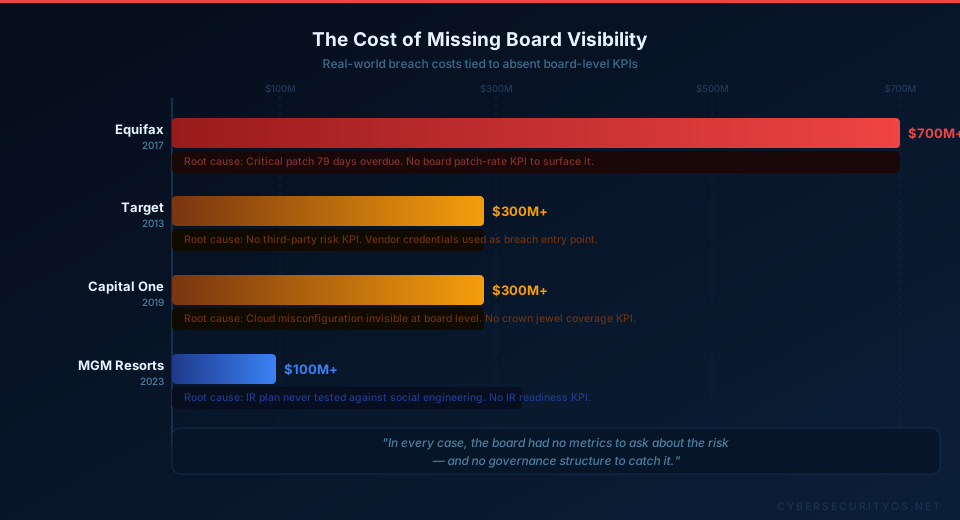
Target (2013): The board had no visibility into real-time threat detection or third-party vendor access. An HVAC vendor’s credentials were used to access the payment network. 40 million credit card records were stolen. The CEO and CISO both resigned. Total cost: over $300M.
Equifax (2017): A critical Apache Struts patch was available 79 days before the breach. A board-level patch rate KPI would have surfaced this overdue item. Instead, the board had no visibility into vulnerability remediation performance. The breach exposed 147 million records. Settlement: $700M.
Capital One (2019): A misconfigured AWS WAF enabled an attacker to access 100 million customer records. The CISO lacked a cloud security posture metric on the board dashboard. Cost: over $300M in regulatory fines, settlements, and remediation.
SolarWinds (2020): 18,000+ organizations were compromised through a malicious software update from a trusted vendor. Almost no organization had third-party risk exposure as a board-level KPI. The attacker had months of undetected access — MTTD had no board-level visibility.
In each case, the failure was not that the CISO didn’t know about the risk. The failure was that the board had no metrics to ask about it — and no structure to govern it.
The One-Page Board Security Dashboard
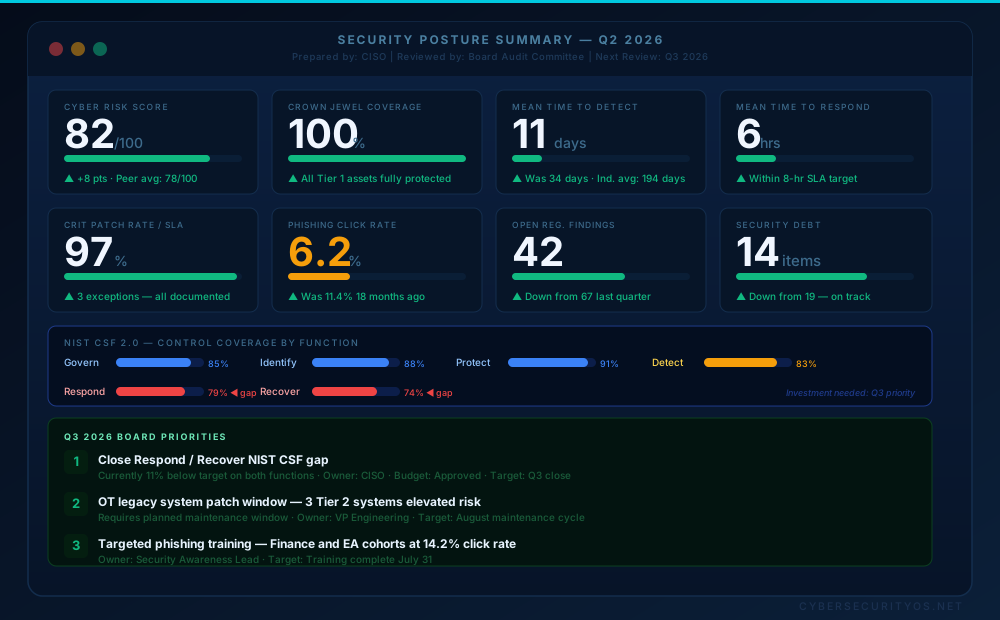
The most effective board reporting format is a single page, updated quarterly, with five to seven KPIs and a clear trend indicator (up/down/stable) for each.
Structure:
┌────────────────────────────────────────────────────────────┐
│  SECURITY POSTURE SUMMARY — Q2 2026                         │
│  Prepared by: [CISO Name]  │  Reviewed by: [Board Chair]   │
├──────────────────────┬──────────┬───────────┬──────────────┤
│ KPI                  │ Current  │ Prior Qtr │ Status       │
├──────────────────────┼──────────┼───────────┼──────────────┤
│ Cyber Risk Score     │ 82/100   │ 74/100    │ ▲ Improving  │
│ Crown Jewel Coverage │ 100%     │ 94%       │ ▲ On Target  │
│ Crit Patch Rate/SLA  │ 97%      │ 91%       │ ▲ On Target  │
│ MTTD (avg, days)     │ 11       │ 34        │ ▲ Improving  │
│ MTTR (avg, hours)    │ 6h       │ 11h       │ ▲ On Target  │
│ Phishing Click Rate  │ 6.2%     │ 9.1%      │ ▲ Improving  │
│ Open Reg. Findings   │ 42       │ 67        │ ▲ Improving  │
│ Security Debt (open) │ 14 items │ 19 items  │ ▲ Reducing   │
├──────────────────────┴──────────┴───────────┴──────────────┤
│ Q3 PRIORITIES                                               │
│  1. Close Respond/Recover NIST CSF gap (11% behind target) │
│  2. OT system patch window — 3 legacy systems at risk       │
│  3. Targeted phishing training for Finance / EA cohorts     │
└────────────────────────────────────────────────────────────┘
One page. Trend visible at a glance. Three forward-looking priorities that the board can ask about next quarter. This is governance — not a status report.
The Three Mistakes That Kill Security Board Reporting
1. Reporting activity instead of outcomes. “We triaged 12,000 alerts” is activity. “Our MTTD dropped from 34 days to 11 days” is an outcome. Boards govern outcomes, not activities.
2. Showing snapshots without trends. Any single metric in isolation is ambiguous. A phishing click rate of 8% is alarming if it was 4% last quarter. It’s a success if it was 18% last year. Always show the trend.
3. Skipping the narrative. Numbers without context force the board to interpret them — and they will, usually worse than the reality. The CISO’s job is to tell the story: here’s what the numbers mean, here’s what caused the trend, here’s what we’re doing about it, here’s what we need from you.
Key Takeaways
- Board security reporting should answer three questions: Are we exposed? Can we recover? Are we doing what we said?
- Tier 1 (Risk): Cyber Risk Score, Crown Jewel Coverage, Third-Party Risk, Quantified ALE
- Tier 2 (Resilience): MTTD, MTTR, Critical Patch Rate, IR Readiness Score
- Tier 3 (Compliance): Regulatory Finding Trend, NIST/ISO Control Coverage, Phishing Click Rate
- Tier 4 (Business): Security ROI, Security Debt, Time to Secure
- Present as a one-page dashboard with trend indicators — not a 40-slide deck
- SEC 2023 rules make board security governance a legal obligation for public companies
- The failures at Target, Equifax, Capital One, and SolarWinds all had a board visibility failure at their root
💡 Ready to lead security at the executive level?
The Cybersecurity Leadership OS gives you the frameworks to run board-level risk conversations, build security programs that scale, and communicate risk in language executives act on. 🔗 Get the Cybersecurity Leadership OS →
Further Reading & Sources
- IBM Cost of a Data Breach Report 2023 — MTTD/MTTR cost impact data
- Verizon Data Breach Investigations Report 2024 — human element statistics
- SEC Cybersecurity Disclosure Rules (2023) — governance and reporting requirements
- NIST CSF 2.0 — updated framework with Govern function
- ISO/IEC 27001:2022 — management review requirements (Clause 9.3)
- FAIR Institute — quantitative cyber risk (ALE methodology)
- Phil Venables — On Metrics — CISO perspective on measuring what matters
- SecurityScorecard Research — external risk rating benchmarks
- CISA Cross-Sector Cybersecurity Performance Goals — baseline control targets
Thanks for reading,
Michael
If you enjoy the content, then consider buying me a coffee.