Posts
Entry Level Cybersecurity Jobs in 2027: The Honest Read
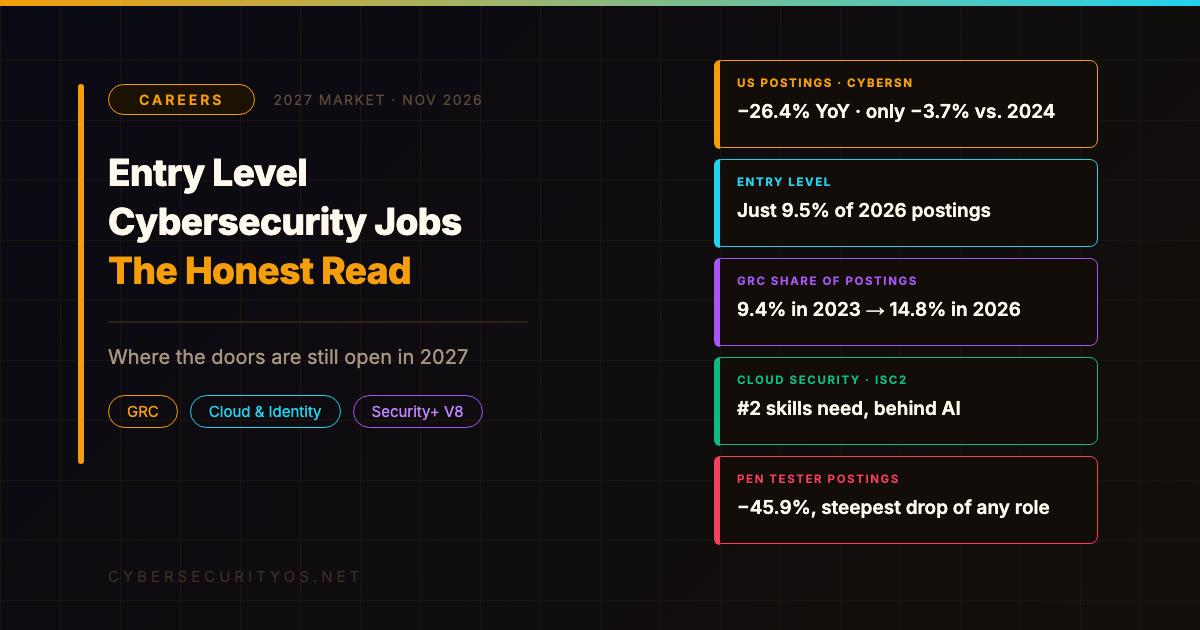
US cybersecurity job postings fell 26.4% this year, according to CyberSN. And only 9.5% of the 235,786 postings were labeled entry level.
If you’re trying to break in, that second number is the one that stings. It’s also not the whole story.
The short answer: entry level cybersecurity jobs still exist in 2027, but there are fewer of them, and most don’t say “entry level” on the label. The realistic ways in run through GRC, IT and help desk, and cloud and identity, not straight into pen testing. One foundational cert plus visible proof of work still gets people hired.
The full breakdown, including salary bands and all 7 career paths, is in our free 2027 career guide.
Did cybersecurity jobs really drop 26% in 2026?
Yes, but the comparison matters. CyberSN measured January to September 2026 against the same months of 2025, and 2025 was an unusually strong year. Compared to 2024, 2026 is down only about 3.7%.
So the market didn’t collapse. It cooled back to normal after a hot year.
The flip side is also true. CyberSeek counted 514,359 US cybersecurity job listings from May 2024 to April 2025. That’s listings over twelve months, not open seats waiting for you today. ISC2 has even stopped publishing its “workforce gap” number.
What to do about it: ignore both the “500,000 jobs are waiting” posts and the “cyber is dead” posts. Neither one tells you what to do on Monday. Track postings for the one role you’re targeting instead.
How many entry level cybersecurity jobs are there?
Not many on paper. According to CyberSN, about 1 in 10 postings in 2026 was entry level.
The classic first jobs took the biggest hits. Security analyst postings fell 30.5%. Penetration tester postings fell 45.9%, the steepest drop of any major role.
AI is part of the reason. Gartner expects 70% of large security operations centers (SOCs) to pilot AI agents for Tier 1 and Tier 2 work by 2028. That’s the alert-triage work juniors used to cut their teeth on.
But the same surveys point the other way too. According to ISC2, 53% believe AI is creating new entry-level roles, and 62% say AI has not reduced the need for foundational skills. ISACA found 58% of security teams say they’re understaffed, and 49% have open roles right now.
Here’s what that adds up to. Entry level isn’t gone. The door moved. Teams still need people, but they hire juniors into roles that aren’t labeled “junior,” or they promote from IT.
What to do about it: stop searching for the phrase “entry level.” Search by function and skill instead. Apply to roles asking for one to three years if you can show equivalent work in a portfolio or your current job.
Which cybersecurity careers are easiest to break into right now?
Three paths stand out in the data.
GRC (governance, risk, and compliance). GRC grew from 9.4% of postings in 2023 to 14.8% in 2026, according to CyberSN. There’s a credential shortage here too: CyberSeek data shows only about 0.46 CISM holders and 0.68 CISA holders for every listing that asks for them. Those are experienced certs, but the gap tells you demand is outrunning supply. If you come from audit, compliance, legal, or project management, your skills transfer directly.
Cloud and identity. ISC2 ranks cloud security as the number two skills need (36%), right behind AI. If you work help desk, you already do identity work: password resets, multi-factor authentication (MFA), access requests. That’s identity and access management (IAM) with a different job title. (Related: What is a non-human identity?)
IT and help desk into security. According to ISC2, about 25% of hiring managers recruit juniors from outside CS, IT, or cyber. If they’ll take people from outside tech, they’ll certainly look at someone already inside it. Internal moves are often the quietest on-ramp.
Two growing areas are worth watching, but they aren’t first jobs:
- AI security. AI security engineer postings rose 268.3% to 2,409, according to CyberSN. That’s still only about 1% of all postings. Cyber data scientist postings rose 203.5%.
- Research. Research roles were the only function that grew, up 26.1%.
And security engineering is still the most posted role, with 44,083 postings. It’s rarely a first job, but it’s a strong two-to-three-year target.
Not sure which path fits you? This post covers where the doors are open. The Cybersecurity Career Landscape: 2027 Edition adds the career decision framework to pick one of the 7 clusters, portfolio projects for each cluster, and a 12-month action plan to get there. It’s free.
Is Security+ still worth it for entry level jobs?
Yes, as a filter, not a differentiator. CyberSeek data shows about 3.8 Security+ holders for every listing that asks for it. It gets your resume past the screen. It won’t win the interview on its own.
Timing matters this year. CompTIA Security+ V8 (SY0-801) launches November 17, 2026. SY0-701 is expected to remain available until around mid-2027. Either way you earn the same credential, valid for three years.
If you’re mid-study on 701, finish it. If you’re starting fresh after launch, study for V8.
Skip the shiny stuff for now. The new AI certs, CompTIA SecAI+, ISACA AAISM, and IAPP AIGP, are aimed at people with experience. SecAI+ targets practitioners with three to four years in, and AAISM requires CISM or CISSP. CISSP is the most requested cert (82,494 listings), but it’s an experienced-practitioner cert too.
One more reason not to overspend on certs: ISACA found 61% of employers pay certification fees. Get hired, then let them fund the next one.
What do entry level cybersecurity jobs pay?
According to BLS, the median pay for information security analysts was $129,180 in May 2025. The bottom 10% earned under $75,090, and the top 10% earned over $199,850.
Entry-level offers sit toward the lower end of that range. The median is what people earn after some years in the job.
The long-term outlook is strong. BLS projects 21% growth for the role from 2025 to 2035, compared to 3% for all jobs, with about 14,100 openings a year.
Further up the ladder, Robert Half puts the 2027 cybersecurity engineer midpoint at $148,500, up 3.1%, while tech salaries overall rose 2.1%. And 92% of tech leaders say they pay more for AI skills.
What to do about it: take the first security title even if the pay is modest. The jump from your first security role to your second is where pay moves fastest.
Do this next
- Pick one path for the next 90 days. GRC, cloud and identity, or blue team. Not all three.
- Get Security+ on the right exam. Finish SY0-701 if you’ve started. Otherwise, plan for V8 after November 17.
- Build one project that matches your path. GRC: map a small organization’s controls to a framework and write the gap report. Cloud and identity: set up a free-tier tenant with MFA, conditional access, and logging turned on. Blue team: run a home lab and write up one detection. (Example lab: Zero Trust on a $0 Budget with Cloudflare One)
- Rewrite your current job in security terms. “Reset passwords” becomes “handled access management for 300 users.” Be accurate, but use the language security hiring managers search for.
- Practice explaining your project in two minutes. ISACA found soft skills are the number one skills gap (57%), with critical thinking at 59% and communication at 57%. Clear explanation is a hiring advantage.
FAQ
Are there still entry level cybersecurity jobs in 2027? Yes, but fewer than the hype suggests. According to CyberSN, only 9.5% of 2026 postings were entry level. Many juniors get hired into roles without the label, or move over from IT.
What’s the easiest cybersecurity path to break into? GRC and cloud and identity are the most open doors. GRC grew from 9.4% to 14.8% of postings since 2023 according to CyberSN, and ISC2 ranks cloud security as the number two skills need.
Should I take Security+ SY0-701 or wait for V8? Finish 701 if you’ve already started. It’s expected to stay available until around mid-2027 and it’s the same credential as V8. Starting from zero after November 17, 2026? Study for V8.
Will AI eliminate entry level cybersecurity jobs? It will change Tier 1 work, and Gartner expects most large SOCs to pilot AI agents for it by 2028. But according to ISC2, 53% believe AI is creating new entry-level roles, and 62% say it hasn’t reduced the need for foundational skills.
Do I need a computer science degree? No. According to ISC2, about 25% of hiring managers recruit juniors from outside CS, IT, or cyber. Proof of work and clear communication matter more than the degree.
Get the full 2027 picture
This post answered one question: where entry level cybersecurity jobs still are. The guide answers the next five: which of the 7 career paths fits you, what each pays from entry level to CISO, which certs to get and when, what to build for your portfolio, and how to talk about it in interviews.
Download the Cybersecurity Career Landscape: 2027 Edition. It’s free.